
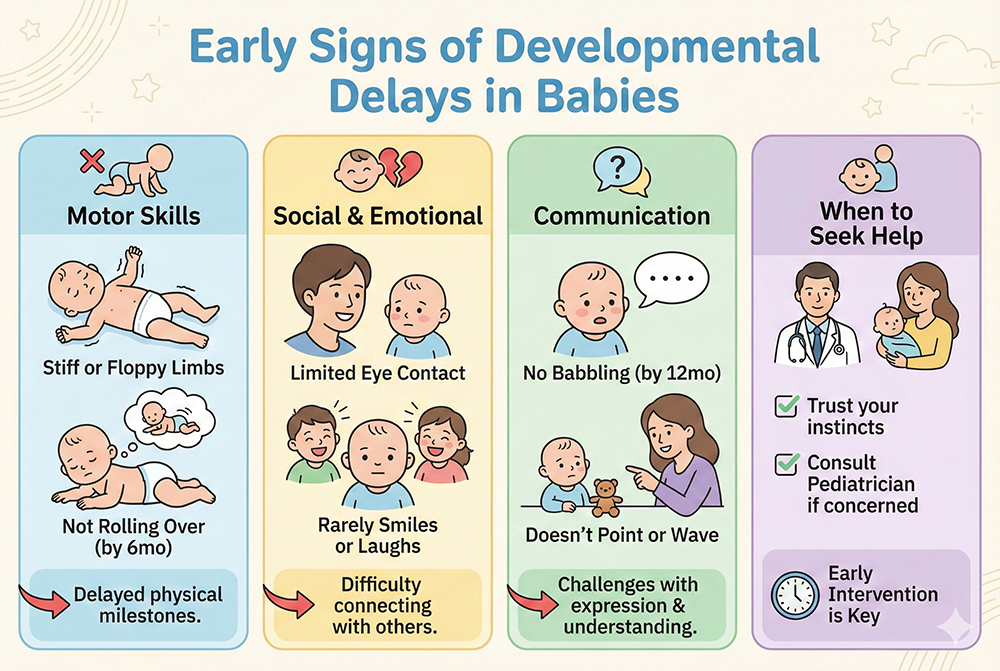
Why Early Detection Matters (and Why It’s Not About Blame)
Every baby develops at their own pace, but developmental milestones give us helpful windows into how a baby’s brain and body are growing. Noticing possible early signs of developmental delays in babies doesn’t mean something is “wrong” or that you did anything wrong—it simply means your child may benefit from extra support. Research consistently shows that early identification and early intervention can improve outcomes in communication, motor skills, learning, and social development.
Developmental delays are common and can be mild or more significant. Some delays resolve with time and support, while others signal conditions like hearing or vision impairment, autism spectrum disorder (ASD), cerebral palsy, or global developmental delay. The goal is to observe, document, and partner with your pediatrician so your baby gets the help they need as early as possible.
Understanding Developmental Milestones (and What “Delay” Means)
Milestones are skills most babies achieve within a typical age range. Pediatricians often look at four major developmental domains:
- Gross motor: big movements (rolling, sitting, crawling, walking)
- Fine motor: small movements (grasping, transferring objects)
- Speech and language: babbling, responding to sounds, first words
- Social and emotional / cognitive: smiling, eye contact, imitation, problem-solving
A developmental delay generally means a baby is not meeting expected milestones in one or more domains compared to peers. Doctors consider the whole picture—prematurity, medical history, family history, and the baby’s growth pattern—rather than relying on a single milestone.
Adjusted age for premature babies
If your baby was born preterm, milestones are often assessed using adjusted age (chronological age minus weeks early), especially in the first 2 years. For example, a baby born 8 weeks early may reach milestones about 8 weeks later than a full-term baby, which can be completely typical.
Early Signs of Developmental Delays by Age: What to Watch For
Below are common milestone red flags. This list is not meant to diagnose—only to help you decide when to check in with your pediatrician.
Birth to 3 months: early social, feeding, and movement cues
- Limited responsiveness: rarely reacts to loud sounds, bright lights, or faces
- Feeding difficulties: trouble sucking/swallowing, frequent choking/coughing, very tiring feeds
- Very stiff or very floppy muscle tone: feels rigid when held or extremely “loose”
- Minimal movement on one side: persistent preference for turning head one way, or one arm/leg moving less
- By ~2 months: not smiling at people or showing joyful engagement
- By ~3 months: not bringing hands to mouth, not following moving objects with eyes (some variation is normal)
4 to 6 months: head control, reaching, and interaction
- Poor head control or head still bobbing significantly when supported
- Not reaching for toys or bringing objects toward mouth by around 5–6 months
- Limited social interaction: little smiling, laughing, or back-and-forth engagement
- Doesn’t respond to sounds consistently or doesn’t turn toward voices
- Not rolling in either direction by around 6 months (ranges vary)
- Persistent clenched fists or very stiff legs/arching most of the time
7 to 9 months: sitting, babbling, and curiosity
- Not sitting with help by ~7 months or independently by ~9 months
- Not babbling (e.g., “bababa,” “dadada”) or very limited vocal play
- Little interest in interaction: limited eye contact, smiles, or response to name (response to name can vary)
- Not bearing weight on legs at all when supported (some babies are cautious, but complete refusal warrants a check)
- Not transferring objects from one hand to the other
- Loss of skills previously achieved (always an urgent reason to call your doctor)
10 to 12 months: communication and mobility
- Not crawling or not moving toward objects of interest (some babies skip crawling, but they should be mobile in some way)
- Not pulling to stand or not standing with support by ~12 months
- No gestures like pointing, waving, or showing objects by ~12 months
- Not using simple sounds or words meaningfully (some babies have few words at 12 months, but should communicate needs)
- Doesn’t seem to understand simple words like “no,” “bye-bye,” or familiar names (varies, but lack of comprehension can be a sign)
- Persistent toe standing or strongly asymmetric movement patterns
12 to 18 months: walking, words, and understanding
- Not walking independently by ~18 months
- No single words by ~16 months (or very limited attempts to communicate)
- Doesn’t imitate actions (clapping, simple play) or show interest in interactive games
- Doesn’t point to show interest or share attention by ~18 months
- Frequent loss of skills or plateau (discuss promptly)
Signs by Developmental Domain (A Parent-Friendly Checklist)
Sometimes delays don’t show up neatly by age. Looking at patterns across domains can be more helpful.
Speech and language delay signs
- Limited cooing/babbling or very quiet baby
- Doesn’t respond to sound or doesn’t turn toward voices
- No back-and-forth vocal play (you talk, baby vocalizes back) by later infancy
- Few gestures (pointing, waving, reaching up) by 12 months
Important: Hearing issues can look like speech delay. Even mild hearing loss from recurrent fluid or infections can affect language development.
Gross motor delay signs
- Persistent head lag beyond early infancy
- Not rolling, sitting, or standing within expected ranges
- Stiffness, scissoring legs, or persistent toe walking
- One-sided preference (always using one hand early, dragging one side)
Fine motor delay signs
- Not reaching/grasping for toys by mid-infancy
- Difficulty bringing hands together or transferring objects
- Strong hand preference before 12 months (can signal weakness on one side)
Social, emotional, and cognitive delay signs
- Limited eye contact or social smiles
- Rarely seeks comfort or doesn’t enjoy interactive games (peekaboo)
- Doesn’t share attention (showing you things, pointing to interest) by ~12–18 months
- Repetitive behaviors or unusual sensory responses (extreme distress to sounds/textures, or seeming not to notice)
When to Call the Pediatrician (and When to Act Fast)
Trust your instincts. If something feels “off,” it’s reasonable to ask for a developmental check—even if friends or family say, “They’ll grow out of it.”
Call your pediatrician soon if you notice:
- Missing multiple milestones in one domain (e.g., motor skills)
- Any significant feeding/swallowing challenges
- Concerns about hearing, vision, or persistent eye crossing beyond early infancy
- Persistent stiffness or floppiness
- Little to no babbling by 9 months
- No gestures by 12 months
- No words by 16 months
- Not walking by 18 months
Seek urgent medical advice if:
- Regression: your baby loses skills they previously had (speech, movement, social engagement)
- Seizure-like episodes (staring spells with unresponsiveness, rhythmic jerking)
- Significant trouble breathing or turning blue with feeds
- Severe lethargy or sudden weakness
How Developmental Screening Works (What to Expect at Visits)
Most pediatric practices use standardized tools at certain well-child visits (often around 9, 18, and 24 or 30 months), and autism-specific screening is commonly done at 18 and 24 months. Screening is different from diagnosis—it identifies children who may need a closer look.
You can help by bringing:
- A short list of concerns (2–5 bullets)
- Examples (e.g., “doesn’t babble,” “always uses left hand”)
- Videos of behaviors you’ve noticed (30–60 seconds can be very useful)
- A timeline of when skills appeared (or didn’t)
Internal link suggestion: Link to a post about “Baby milestones by month” or “What happens at the 9-month / 18-month checkup.”
Practical Ways Parents Can Support Development at Home
You don’t need special equipment to support healthy development—consistent, responsive interaction is powerful. These tips are evidence-informed and broadly helpful, whether your baby is on track or needs extra support.
For speech and language development
- Talk during routines: narrate diaper changes, meals, bath time (“Now we’re washing your hands”).
- Serve-and-return: when your baby coos or babbles, respond as if it’s a conversation.
- Read daily: simple board books, repeating favorite stories, pointing to pictures.
- Sing and use rhythm: songs and nursery rhymes support listening skills and sound patterns.
- Reduce background noise: keep TV on low/off during play to make speech easier to hear.
For gross motor skills
- Tummy time in short, frequent sessions (as tolerated), starting early and building up.
- Floor time over containers: limit long periods in swings, bouncers, or car seats when not traveling.
- Encourage reaching: place toys slightly out of reach to motivate rolling/crawling.
- Support sitting safely: sit on the floor with pillows nearby rather than relying on seated “training” devices.
For fine motor skills
- Offer easy-to-grasp toys (soft blocks, rattles, textured rings).
- Practice transferring by handing toys from one side to the other.
- Finger feeding (age-appropriate and safe) supports pincer grasp and coordination.
For social-emotional and cognitive development
- Face-to-face play: mirror your baby’s expressions, smile, and pause for their response.
- Interactive games: peekaboo, pat-a-cake, turn-taking with simple toys.
- Follow your baby’s lead: join what they’re interested in, then gently expand the play.
- Predictable routines: consistent sleep and feeding rhythms support regulation and learning.
Common Causes and Risk Factors (Without Jumping to Conclusions)
Sometimes there’s a clear reason for a developmental delay; other times, the cause is multifactorial or unknown. Potential contributors include:
- Prematurity and low birth weight
- Hearing or vision impairments
- Genetic or metabolic conditions
- Neuromuscular conditions affecting tone and movement
- Environmental factors (limited opportunities for interaction, high stress, inadequate nutrition)
- Medical issues such as chronic illness or severe reflux impacting feeding/growth
What matters most is not guessing the cause at home—it’s ensuring your baby gets an appropriate evaluation and support.
How Early Intervention Helps (and How to Access It)
If your pediatrician is concerned, they may recommend referrals such as:
- Early intervention programs (publicly funded services in many regions for children under 3)
- Speech-language therapy
- Physical therapy for gross motor and strength
- Occupational therapy for fine motor, sensory processing, and feeding support
- Audiology (hearing evaluation) and/or vision assessment
- Developmental-behavioral pediatrics or pediatric neurology when needed
Early intervention is often play-based and designed to coach caregivers, not replace you. Many families find that a few targeted strategies make daily routines easier and less stressful.
Internal link suggestion: If you have a resource page on local parenting support or therapy options, link it here as “How to find early intervention services near you.”
How to Talk to Your Pediatrician: A Simple Script
If you’re nervous about bringing up concerns, you’re not alone. Here are phrases that can help you be clear and specific:
- “I’m noticing my baby isn’t doing X yet, and I’m worried.”
- “Here are two short videos that show what I mean.”
- “Can we do a developmental screening today?”
- “If we wait and see, what would be the next milestone and by when?”
- “Can we refer to early intervention/audiology just to be safe?”
It’s appropriate to ask for a follow-up plan and specific timelines—especially if your gut says you need more than reassurance.
Supporting Yourself as a Parent (Because This Can Feel Heavy)
Worrying about developmental delays can be emotionally exhausting. Many parents cycle through denial, guilt, fear, and relief once they have a plan. A few reminders that can help:
- You didn’t cause this by missing a milestone.
- Asking for help is a parenting strength.
- Your baby is still your baby—with the same need for love, play, and connection.
If anxiety is taking over your day-to-day functioning, consider talking with your pediatrician or a mental health professional. Caring for your well-being supports your baby’s well-being too.
Key Takeaways: What Parents Should Watch For
- Milestones vary, but patterns (missing multiple skills, asymmetry, or limited engagement) matter.
- Regression—losing skills—is always a reason to call your doctor promptly.
- Concerns about hearing, vision, feeding, muscle tone, or social engagement deserve early evaluation.
- Early intervention works best when started early and often feels like guided, playful coaching.
- Document what you see, bring examples, and partner with your pediatrician for next steps.
Medical note: This article is educational and not a substitute for medical advice. If you’re concerned about your baby’s development, contact your pediatrician or local early intervention provider.