The first 12 months of a baby’s life represent the fastest period of physical, cognitive, and social development. The right activities during this stage enhance sensory awareness, strengthen motor skills, and deepen the parent–baby bond. In this guide, you will find easy and development-supportive activity ideas for babies aged 0–12 months, organized by age group.
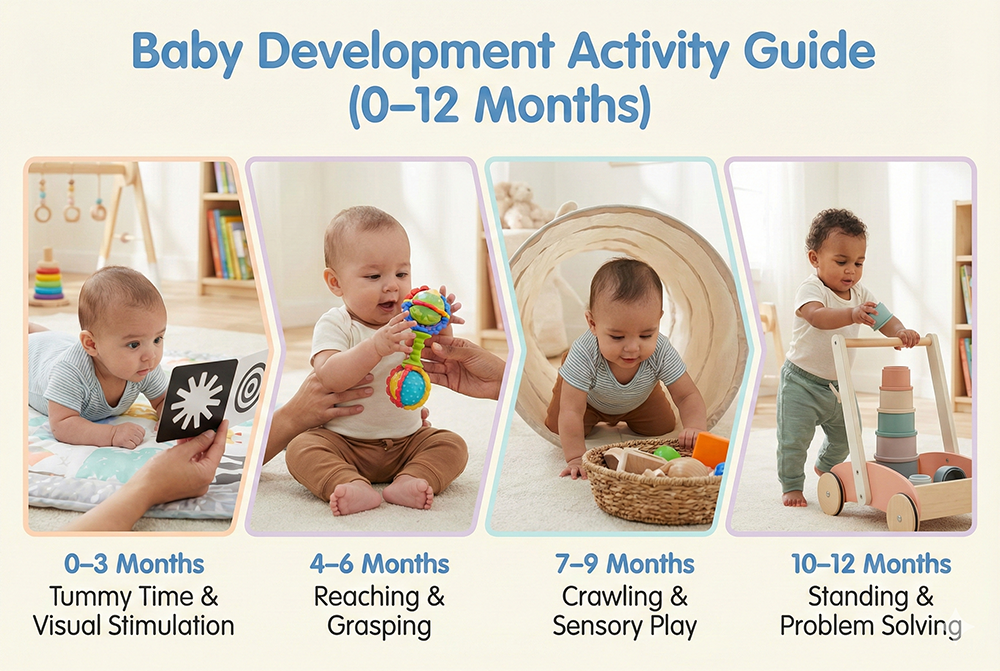
0–3 Months Baby Activity Ideas
The first three months are a gradual introduction to the outside world. During this stage, baby activities should focus mainly on sensory stimulation and basic motor development.
Visual Stimulation with High-Contrast Cards
Black-and-white contrast cards support newborn visual development. Hold the card about 20–30 cm away and slowly move it left to right to encourage eye tracking.
Tummy Time
Tummy time is essential for strengthening neck and back muscles. Practicing short sessions several times a day significantly supports motor development.
Facial Expression and Mimic Games
Make eye contact, smile, raise your eyebrows, and exaggerate facial expressions. Babies at this stage are especially fascinated by faces.
Soft Sounds and Gentle Music
Light rattles, soft music, or a parent’s voice help develop auditory skills. Babies begin learning to locate sound sources during this period.
3–6 Months Baby Activity Ideas
During these months, babies become more active, reach for objects, and interact more with their environment.
Sound Tracking Game
Move a rattle or soft-sounding toy from side to side to encourage your baby to follow the sound.
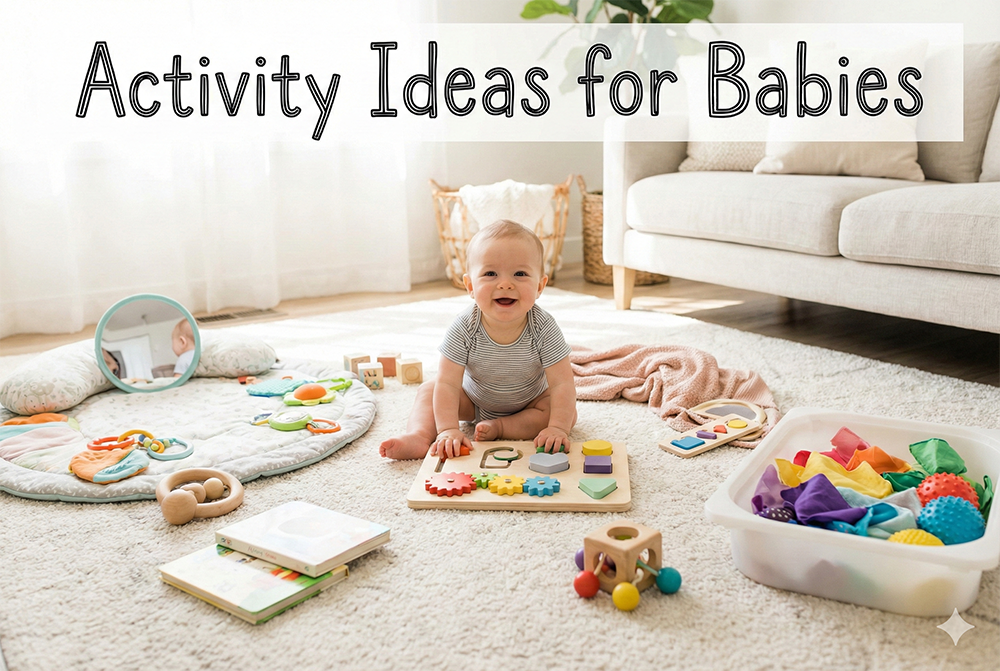
Mirror Observation
Babies enjoy watching their reflections. This activity supports attention span and social awareness.
Sensory Exploration Basket
Prepare a safe basket with different textures such as cotton, sponge, and velvet to encourage sensory discovery.
Mobiles and Hanging Toys
Slowly moving colorful mobiles are excellent for visual tracking and focus development.
6–9 Months Baby Activity Ideas
From six months onward, babies become increasingly mobile. Crawling, object control, and fine motor skills become more prominent.
Hide-and-Find (Peek-a-Boo) Game
Hide a toy under a cloth and encourage your baby to find it. This activity strengthens object permanence.
Put-In, Take-Out Game
Placing blocks or soft toys into a box and taking them out enhances hand-eye coordination.
Crawling Obstacle Course
Create a small obstacle course using pillows and cushions to motivate crawling.
Water Play
Supervised splashing and pouring water during bath time strongly support sensory development.
9–12 Months Baby Activity Ideas
During this period, babies play more intentionally, social communication increases, and preparation for walking begins.
Simple Task Games
Give small instructions such as “Give me the ball” or “Bring the teddy bear.” This strengthens cognitive understanding.
Stacking and Knocking Down Blocks
Babies love stacking and knocking down blocks. This game is excellent for fine motor skill development.
Ring Stacking Toys
Montessori-style ring stackers improve hand-eye coordination and problem-solving skills.
Sound Imitation Games
Imitating animal sounds or vehicle noises supports language development and increases social interaction.
Notes for Parents
Every activity you do with your baby supports both development and emotional bonding. There is no need for perfection — what matters most is interaction. Remember that each baby develops at their own pace. Use these ideas as a general guide and adapt them according to your baby’s interests and readiness.