Understanding Low-Grade Fever in Toddlers
It can feel unsettling to touch your toddler’s forehead and realize they’re warmer than usual—especially when there are no other symptoms like cough, runny nose, vomiting, or a rash. The good news is that a low-grade fever in toddlers is common and often short-lived.
A fever is not an illness by itself. It’s a sign that the immune system is working. Many mild fevers resolve on their own, and your child may continue to play, eat, and sleep fairly normally. Still, it’s important to know what counts as a low-grade fever, what might cause it, and when a “fever with no other symptoms” needs medical attention.
What temperature is considered a low-grade fever?
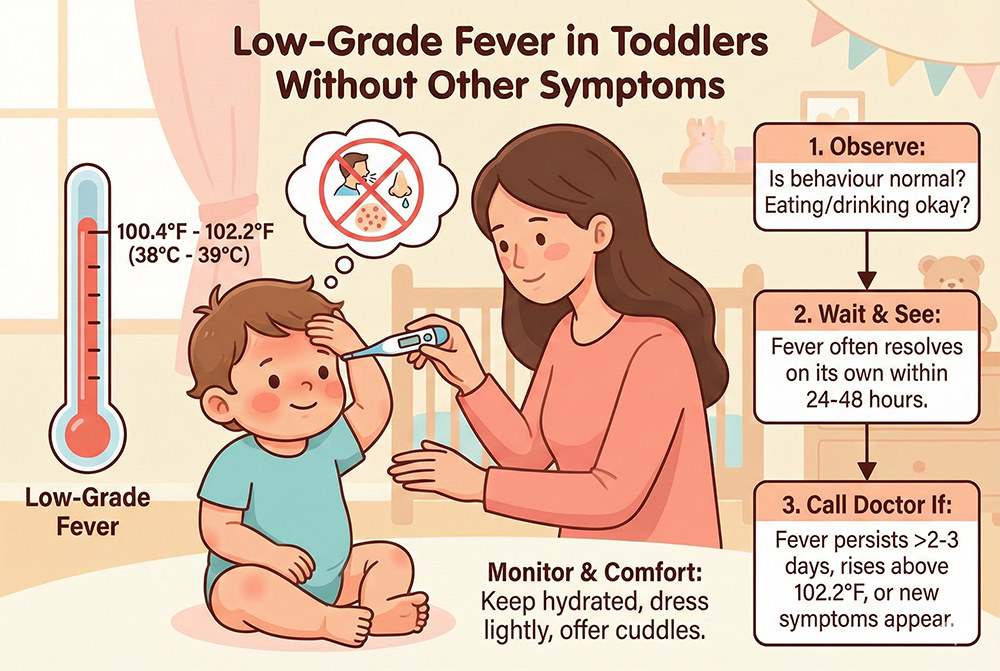
In toddlers, many clinicians consider a low-grade fever to be roughly 100.4°F to 102.2°F (38°C to 39°C). In general, 100.4°F (38°C) or higher is the standard threshold for fever.
Why fever alone can happen
Toddlers’ immune systems are constantly learning. Sometimes the first (or only) sign of a minor infection or immune response is a mild temperature elevation. Symptoms can also lag behind the fever by 24–48 hours, meaning you may see fever first, then a cold, rash, or diarrhea later.
How to Take Your Toddler’s Temperature Accurately
Before worrying about “a low-grade fever with no other symptoms,” make sure the temperature reading is reliable. A few tenths of a degree can change how you respond.
Best thermometer methods for toddlers
- Rectal: Most accurate for core temperature; often used for babies, but can be used in toddlers if needed and done safely.
- Oral: Accurate if your child can hold the thermometer under the tongue with mouth closed (often not reliable until older).
- Axillary (armpit): Convenient, but less accurate; tends to read lower than core temperature.
- Tympanic (ear): Can be accurate when used correctly; earwax or improper positioning can skew results.
- Temporal (forehead scan): Easy and quick; can be affected by sweat, room temperature, or technique.
Tips to improve accuracy
- Read the thermometer instructions (each brand differs).
- Take the temperature when your child has been indoors and resting for 10–15 minutes.
- Avoid measuring right after a warm bath, heavy activity, or bundling.
- If the reading seems surprising, repeat it in 10–15 minutes using the same method.
Practical note: Treat the child, not just the number. A playful toddler with a 101°F fever often needs less intervention than a listless child with a lower temperature.
Common Causes of Low-Grade Fever in Toddlers With No Other Symptoms
There are several reasons a toddler may have a mild fever without obvious symptoms. Some are harmless and temporary; others may need evaluation if the fever persists.
1) Early viral infection (symptoms haven’t started yet)
Many viral illnesses begin with fever before other symptoms develop. Your toddler might get a runny nose, cough, sore throat, mild diarrhea, or a rash a day or two later. Common examples include routine “cold” viruses and other self-limited infections.
2) Roseola (fever first, rash later)
Roseola is known for several days of fever followed by a rash that appears as the fever breaks. During the fever phase, some toddlers look surprisingly well—making it seem like a “fever with no other symptoms.”
3) Teething (a small temperature rise, but usually not a true fever)
Teething can cause drooling, gum discomfort, and fussiness. It may slightly raise temperature, but it typically does not cause a true fever of 100.4°F (38°C) or higher. If your toddler has a real fever, it’s wise to consider other causes rather than attributing it solely to teething.
4) Overheating and environmental warmth
Toddlers can get warm from overdressing, a warm room, heavy blankets, or vigorous activity. Once they cool down and rest, the temperature should normalize. Overheating is more likely to cause a low-grade temperature rather than a sustained fever.
5) Recent vaccinations
Some vaccines can trigger a mild fever within 24–48 hours (sometimes longer depending on the vaccine). This is a normal immune response. Watch hydration and comfort, and follow your clinician’s guidance on fever medicine if needed.
6) Ear infection (sometimes subtle)
Ear infections can sometimes present with fever but minimal other symptoms at first. Some toddlers may tug their ear, have disrupted sleep, or become irritable—signs that can be easy to miss.
7) Urinary tract infection (UTI)
A UTI is an important cause of fever without other symptoms, especially in younger children. Some toddlers may not report pain with urination. Other hints can include new accidents, foul-smelling urine, belly pain, or fussiness. Because UTIs require treatment, persistent fever without a clear source should prompt consideration of a urine test.
8) Less common causes
Less common causes include pneumonia (sometimes without a cough early on), strep throat (may present mainly with fever), or inflammatory conditions. These are more likely when fever persists, rises higher, or your child’s behavior changes.
What to Do at Home: Supportive Care That Helps
For a toddler with a low-grade fever and no other symptoms, home care focuses on comfort, hydration, and observation. In many cases, that’s exactly what your child needs.
Focus on how your toddler looks and acts
Ask yourself:
- Are they drinking fluids?
- Are they peeing regularly?
- Are they alert when awake?
- Can they be comforted?
- Are they breathing comfortably?
If the answers are reassuring, supportive care is reasonable while you monitor.
Hydration: your #1 priority
Fever can increase fluid needs. Offer small, frequent sips.
- Best options: water, milk, oral rehydration solutions if intake is low, soups/broths, watery fruits (melon, oranges).
- If appetite is down: that’s common; prioritize fluids over food for a day or two.
Dress for comfort
- Use light layers and keep the room comfortably cool.
- Avoid bundling or heavy blankets.
- Skip alcohol rubs or ice baths (not recommended and can be dangerous).
Rest and quiet play
Your child doesn’t have to stay in bed all day. Calm activities are fine. Sleep may increase—this can be normal when fighting an illness.
Fever-reducing medicine: when (and when not) to use it
Fever medication is mainly for comfort, not to “normalize” the temperature.
- Consider using medication if your toddler is clearly uncomfortable, in pain, not sleeping, or not drinking well due to discomfort.
- If your child is playing and drinking, you may not need to treat the fever.
Common options: Acetaminophen (paracetamol) and ibuprofen are often used in toddlers, but dosing depends on your child’s weight and age. Follow your pediatrician’s instructions or the product label carefully.
Safety reminders:
- Do not give aspirin to children (risk of Reye’s syndrome).
- Do not “stack” combination cold/flu products unless instructed; they can accidentally double-dose fever medicines.
- Track times and doses to avoid giving too much.
How Long Is Too Long? A Parent-Friendly Timeline
Duration matters. A mild fever that resolves quickly is usually less concerning than one that lingers.
If it’s been less than 24 hours
It’s reasonable to monitor at home if your toddler is drinking, peeing, and acting mostly like themselves.
If it’s been 24–48 hours
Continue supportive care, but stay alert for emerging symptoms (cold signs, rash, diarrhea). If no symptoms appear and fever continues, consider contacting your pediatrician for guidance—especially if your child has a history of UTIs or is not fully vaccinated.
If it’s been more than 72 hours (3 days)
A fever lasting >3 days deserves a call or visit, even if it remains low-grade and your toddler seems okay. Persistent fever without a clear source may require an exam and possibly testing (often including a urine test).
When to Call the Doctor (Even if There Are No Other Symptoms)
Trust your instincts. You know your child best. Contact your pediatrician if any of the following apply:
- Your toddler is under 3 months and has a temperature of 100.4°F (38°C) or higher (urgent evaluation is recommended for young infants).
- Fever reaches 104°F (40°C) or higher at any age.
- Fever lasts more than 3 days.
- Your toddler is drinking poorly or peeing much less than usual.
- Your child has significant irritability, seems unusually sleepy, or is hard to wake.
- There is a history of UTIs, kidney problems, or immune system concerns.
- Your toddler has chronic medical conditions or is on medications that affect immunity.
- You suspect a vaccine reaction and the fever is high, prolonged, or your child seems unwell.
Emergency Red Flags: Seek Urgent Care Now
Even without other symptoms, seek urgent medical care or emergency evaluation if your toddler has:
- Difficulty breathing, fast breathing, or pulling in at the ribs
- Bluish lips/face
- Signs of severe dehydration (no urine for 8–12 hours, very dry mouth, no tears when crying, sunken eyes, extreme lethargy)
- Stiff neck, severe headache, or sensitivity to light
- A seizure (including a febrile seizure)
- A non-blanching rash (spots that don’t fade when pressed) or widespread purple bruising-like rash
- Persistent vomiting or inability to keep fluids down
- Severe pain (ear, belly, throat) or inconsolable crying
- Confusion, extreme drowsiness, or a marked change from normal behavior
When in doubt, it’s appropriate to get evaluated—especially if your gut says your child is “not acting right.”
Special Considerations: Fever and Febrile Seizures
Febrile seizures can happen in some children between about 6 months and 5 years. They are usually triggered by a rapid rise in temperature, sometimes early in an illness before other symptoms appear.
Most febrile seizures are brief and do not cause long-term harm, but they are frightening. If your child has a seizure:
- Place them on their side on a safe surface.
- Do not put anything in their mouth.
- Time the seizure.
- Seek urgent medical care, especially if it lasts longer than 5 minutes, occurs repeatedly, or your child does not recover quickly.
Could It Be “Just a Low Fever”? When Normal Variations Matter
Body temperature naturally fluctuates throughout the day and can run slightly higher in the late afternoon and evening. Activity, warm clothing, and even a big cry can raise temperature briefly.
If your toddler’s temperature is between 99°F and 100.3°F (37.2°C to 37.9°C), it may be a normal variation rather than a fever—depending on the measurement method. If it’s 100.4°F (38°C) or higher, consider it a fever and monitor accordingly.
How to Monitor at Home Without Anxiety Spirals
It’s easy to get stuck checking the thermometer every 30 minutes. Instead, use a calm plan that keeps your toddler safe and helps you feel grounded.
A simple monitoring plan
- Check temperature every 4–6 hours while awake, or sooner if your child seems worse.
- Track fluids and urine: note roughly how much they drink and how often they wet diapers/use the toilet.
- Observe energy: are there stretches of play or interest in activities?
- Note new symptoms: cough, runny nose, rash, diarrhea, ear tugging, pain with peeing.
What to write down for the pediatrician
- Highest temperature and how it was taken (forehead, ear, etc.)
- When fever started
- Any medicines given (dose, time)
- Hydration and urine output
- Any exposures (sick contacts, daycare outbreaks)
- Recent vaccines or travel
This information helps clinicians decide whether testing is needed and which tests are most useful.
Preventing Future Illness (Realistic, Parent-Friendly Steps)
You can’t prevent every fever—nor should you try. Fevers are part of how kids build immunity. But you can reduce the risk of frequent infections and support overall health.
- Hand hygiene: wash hands after daycare, before meals, and after the bathroom.
- Vaccines: keep immunizations up to date.
- Sleep: adequate sleep supports immune function.
- Nutrition: offer a variety of fruits, vegetables, proteins, and whole grains; picky phases are normal.
- Hydration: encourage water throughout the day.
- Smoke-free environment: reduces respiratory irritation and infection risk.
Reassurance for Parents: You’re Not Missing Something
A low-grade fever in a toddler without other symptoms is often a temporary stage of a common viral illness or immune response. Many parents worry they’re overlooking a serious problem. The key is to watch for patterns: how your child behaves, whether the fever persists, and whether red flags appear.
When you’re unsure, reaching out to your pediatrician is never “overreacting.” It’s part of caring well for your child.