
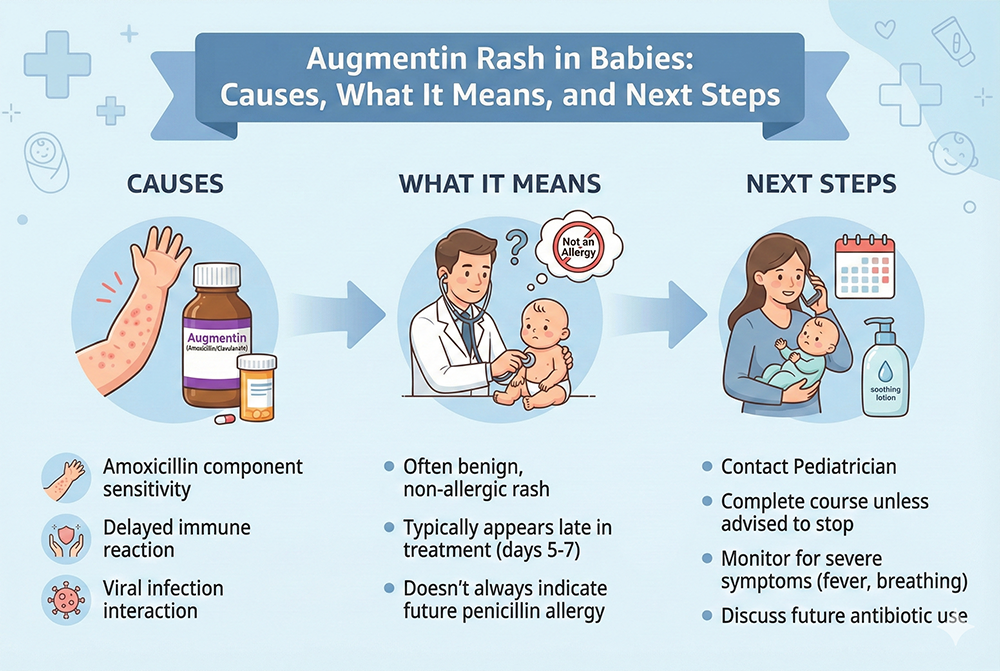
Understanding an Augmentin Rash in Babies
Seeing a new rash on your baby can be alarming—especially when it happens after starting an antibiotic like Augmentin (amoxicillin-clavulanate). The good news is that many rashes that appear during Augmentin treatment are not dangerous and do not necessarily mean your baby has a true penicillin allergy. Still, some reactions can be serious and need urgent medical attention.
This guide will help you understand what an Augmentin rash can look like, the most common causes, how to tell a mild rash from an emergency, and what steps to take to keep your baby safe and comfortable. It is educational and does not replace medical care—if you are concerned, contact your baby’s pediatrician.
What Is Augmentin, and Why Is It Prescribed for Babies?
Augmentin is a combination antibiotic containing amoxicillin (a penicillin-type antibiotic) and clavulanate (which helps amoxicillin work against certain resistant bacteria). Pediatricians may prescribe it for bacterial infections such as:
- Ear infections (otitis media)
- Sinus infections
- Pneumonia or certain lower respiratory infections
- Skin infections
- Bite wounds
Because many childhood illnesses are viral (and antibiotics don’t treat viruses), it’s always reasonable to ask why Augmentin was chosen and whether your child’s symptoms suggest a bacterial infection.
What Does an Augmentin Rash Look Like in a Baby?
Parents often search “augmentin rash baby” because the rash can appear suddenly and look dramatic. Common presentations include:
1) Maculopapular (Morbilliform) Rash
This is one of the most common antibiotic-associated rashes. It may look like:
- Flat pink or red spots mixed with small raised bumps
- Often starts on the trunk and spreads to arms, legs, and face
- May be mildly itchy or not itchy at all
- Usually appears after several doses (often day 3–10), but timing varies
2) Hives (Urticaria)
Hives are raised, itchy welts that can move around the body. They can:
- Appear suddenly and change shape or location over hours
- Be very itchy
- Occasionally signal an allergic reaction, especially if they begin soon after a dose
3) Diaper-Area Rash or Yeast Rash
Antibiotics can disrupt normal skin and gut bacteria, sometimes allowing yeast to overgrow. This can cause:
- Bright red rash in the diaper area
- Rash in skin folds
- Small “satellite” red bumps around the main rash
4) Less Common but Serious Rashes
Some rashes are rare but require urgent evaluation (details below), including blistering rashes, rashes with purple spots, or rash with significant swelling or breathing symptoms.
Why Does a Rash Happen with Augmentin? Common Causes
A rash while taking Augmentin can happen for several reasons. The right next step depends on the likely cause and your baby’s symptoms.
Non-allergic antibiotic rash (common)
A baby can develop a widespread red rash during an illness while on amoxicillin or Augmentin without having a true allergy. This is sometimes called a “benign amoxicillin rash,” although it can occur with Augmentin as well. It may be related to immune activation from the infection itself rather than a dangerous drug allergy.
Viral illness rash (very common in babies)
Many viruses can cause rashes in infants and toddlers (for example, roseola and other respiratory viruses). A rash may show up just as the fever improves, which can be confusing if your baby is also taking Augmentin.
True allergy (possible, sometimes serious)
Some babies do have an allergic reaction to penicillin-class antibiotics. A true IgE-mediated allergy typically causes symptoms like hives, swelling, wheezing, or vomiting soon after a dose (often within minutes to a few hours). This is more concerning than a non-itchy, measles-like rash that appears days into treatment.
Yeast overgrowth (diaper rash or thrush)
Augmentin can change normal bacterial balance, allowing yeast to flourish. Signs can include a stubborn diaper rash or white patches in the mouth (thrush).
Drug reaction requiring urgent care (rare)
Rare immune-mediated reactions can cause severe skin symptoms and systemic illness. While uncommon, it’s important for parents to know the warning signs.
When an Augmentin Rash Is an Emergency
Call emergency services or seek urgent care immediately if your baby has a rash plus any of the following:
- Trouble breathing, wheezing, repetitive coughing, or noisy breathing
- Swelling of lips, tongue, face, or eyelids
- Widespread hives with vomiting, weakness, or lethargy
- Blistering skin, skin peeling, or painful rash
- Rash inside the mouth or on the eyes/genitals, or significant mouth sores
- Purple or bruise-like spots that don’t blanch (fade) when pressed
- High fever plus rash with a very ill appearance
- Neck stiffness, extreme sleepiness, or inconsolable crying with rash
These signs can indicate severe allergic reactions (including anaphylaxis) or serious skin conditions that must be evaluated promptly.
When to Call Your Pediatrician (Same Day)
Even if your baby seems otherwise okay, contact your pediatrician the same day if:
- The rash is spreading quickly
- Your baby seems itchy, uncomfortable, or the rash is disrupting sleep/feeding
- There is facial swelling (even mild)
- The rash looks like hives (raised welts) rather than flat spots
- Your baby has new vomiting or diarrhea with the rash
- Your baby is under 3 months old and develops a rash while on medication
- You are unsure whether to give the next dose
Step-by-Step: What to Do If Your Baby Develops a Rash on Augmentin
In the moment, it helps to have a clear plan.
Step 1: Pause and observe your baby’s overall condition
Look beyond the rash. Is your baby breathing comfortably? Acting like themselves? Feeding reasonably well? A baby who is playful, alert, and breathing normally is less likely to be having a dangerous reaction than a baby who is lethargic, wheezing, or swelling.
Step 2: Note the timing and pattern
Write down:
- When Augmentin was started
- When the rash first appeared
- How long after the last dose the rash appeared
- Whether it looks flat and speckled, or raised and hive-like
- Any other symptoms (fever, itch, swelling, diarrhea, cough)
This information helps your clinician determine whether this is more likely a viral rash, a benign antibiotic rash, or a true allergy.
Step 3: Take clear photos
Good photos (in natural light, from several angles) can be extremely helpful, especially if the rash changes by the time your baby is seen.
Step 4: Contact your pediatrician before stopping or continuing—if possible
Whether to continue Augmentin depends on the rash type and your baby’s medical situation. Stopping early can sometimes lead to incomplete treatment, while continuing during a true allergy can be dangerous. If you cannot reach your pediatrician and your baby has any emergency symptoms, seek urgent care.
Step 5: Comfort care for mild rashes (only if your clinician agrees)
For mild, non-urgent rashes, supportive care may include:
- Cool compresses to relieve irritation
- Fragrance-free moisturizers to support the skin barrier
- Lukewarm baths (avoid hot water)
- Loose, breathable clothing to reduce friction
Do not apply strong topical steroids, medicated creams, or give antihistamines unless your pediatrician advises it, especially in infants.
Is It a Penicillin Allergy? Sorting Out the Confusion
Many children are labeled “penicillin allergic” after a rash, but research shows a large proportion of these labels are inaccurate. That matters because penicillin allergy labels can lead to the use of broader antibiotics that may be less effective, cause more side effects, and contribute to antibiotic resistance.
Clues that suggest a true immediate allergy
- Hives that appear soon after a dose (minutes to a few hours)
- Swelling of lips/face
- Breathing symptoms (wheezing, throat tightness)
- Repeated vomiting shortly after dosing
Clues that suggest a delayed, non-dangerous rash
- Flat or slightly bumpy pink/red rash
- Appears days into treatment (often after multiple doses)
- Minimal itch and no swelling or breathing problems
- Baby otherwise looks well
What about testing?
If your pediatrician suspects the rash was not a true allergy, they may recommend referral to an allergist. Depending on your child’s history, evaluation can include skin testing or a supervised oral challenge. Do not attempt “re-challenging” at home.
Could It Be a Yeast Rash from Augmentin?
Yes—especially if the rash is focused in the diaper area and doesn’t improve with typical diaper rash steps. Signs of a yeast diaper rash include:
- Beefy red rash with sharp borders
- Worse in the skin folds
- Small red “satellite” spots nearby
- Possible thrush (white patches in the mouth)
Contact your pediatrician; treatment may require an antifungal cream and specific diapering strategies.
How to Care for Your Baby’s Skin While You Wait for Medical Advice
When a rash appears, parents often want to act quickly. These gentle steps are generally safe while you’re waiting to speak with a clinician, as long as your baby is stable and has no emergency symptoms:
Gentle skin routine
- Use mild, fragrance-free cleanser or just water for bathing
- Pat skin dry; avoid rubbing
- Moisturize with a simple, fragrance-free emollient
Reduce overheating
Heat and sweat can worsen many rashes. Dress your baby in light layers and keep the room comfortably cool.
Avoid new products
Don’t introduce new lotions, detergents, or “natural” remedies during a medication rash. New products can irritate skin and make it harder to identify the cause.
Diaper-area protection
- Change diapers frequently
- Use a thick barrier ointment (such as petrolatum or zinc oxide) if the rash is in the diaper area
- Give diaper-free time if possible
What Will the Doctor Do?
Your pediatrician will consider your baby’s age, the infection being treated, the rash type, and timing. Possible next steps include:
- Continue Augmentin with monitoring if the rash appears benign and the infection needs treatment
- Stop Augmentin and switch antibiotics if an allergy is suspected or the rash is concerning
- Document the reaction carefully in your child’s medical record
- Recommend follow-up with allergy/immunology if appropriate
- Treat symptoms (for example, guidance on itch relief or diaper yeast treatment)
If Augmentin is stopped, ask whether the infection still requires antibiotics and what signs would suggest the illness is worsening.
How Long Does an Augmentin Rash Last in Babies?
Duration depends on the cause:
- Benign maculopapular rash: often improves within a few days and resolves within 1–2 weeks
- Hives: may come and go over hours to days; needs medical guidance to assess allergy risk
- Yeast diaper rash: improves over several days with appropriate antifungal treatment
If the rash is worsening, not improving, or your baby develops new symptoms, re-contact your pediatrician.
Should Augmentin Go on Your Baby’s Allergy List?
Not automatically. A simple rash during treatment does not always equal allergy. However, any reaction should be recorded with details (rash type, timing, other symptoms). If your child had hives, swelling, breathing symptoms, or a severe skin reaction, that is more consistent with a true allergy and should be treated seriously.
Consider asking your pediatrician whether an allergy evaluation could help clarify the diagnosis in the future. Correct labeling is important for safe, effective antibiotic choices.
Practical Tips to Prevent Future Problems
Use antibiotics only when clearly indicated
If your baby is prescribed Augmentin, it’s okay to ask:
- What infection are we treating?
- Is it definitely bacterial?
- Are there alternatives, and why is Augmentin the best choice?
Give the medicine exactly as directed
Follow dosing instructions carefully, including whether it should be given with food. Augmentin can cause stomach upset in some babies, and taking it with food may help.
Monitor for side effects early
Keep an eye on stools, hydration, and skin. Call if you notice severe diarrhea, signs of dehydration (fewer wet diapers, dry mouth), or a rapidly changing rash.
Support the diaper area during antibiotics
Because antibiotics can make diaper rashes more likely, be proactive with frequent changes and barrier creams if your baby is prone to irritation.
Reassurance for Parents
If your baby develops a rash while taking Augmentin, you didn’t do anything wrong. Rashes are common in infancy, and timing can overlap with antibiotics even when the antibiotic isn’t the true cause. Your role is to watch for the red flags, document what you see, and get medical guidance promptly. With the right evaluation, most babies recover quickly—and many can safely use penicillin-family antibiotics in the future if they are not truly allergic.