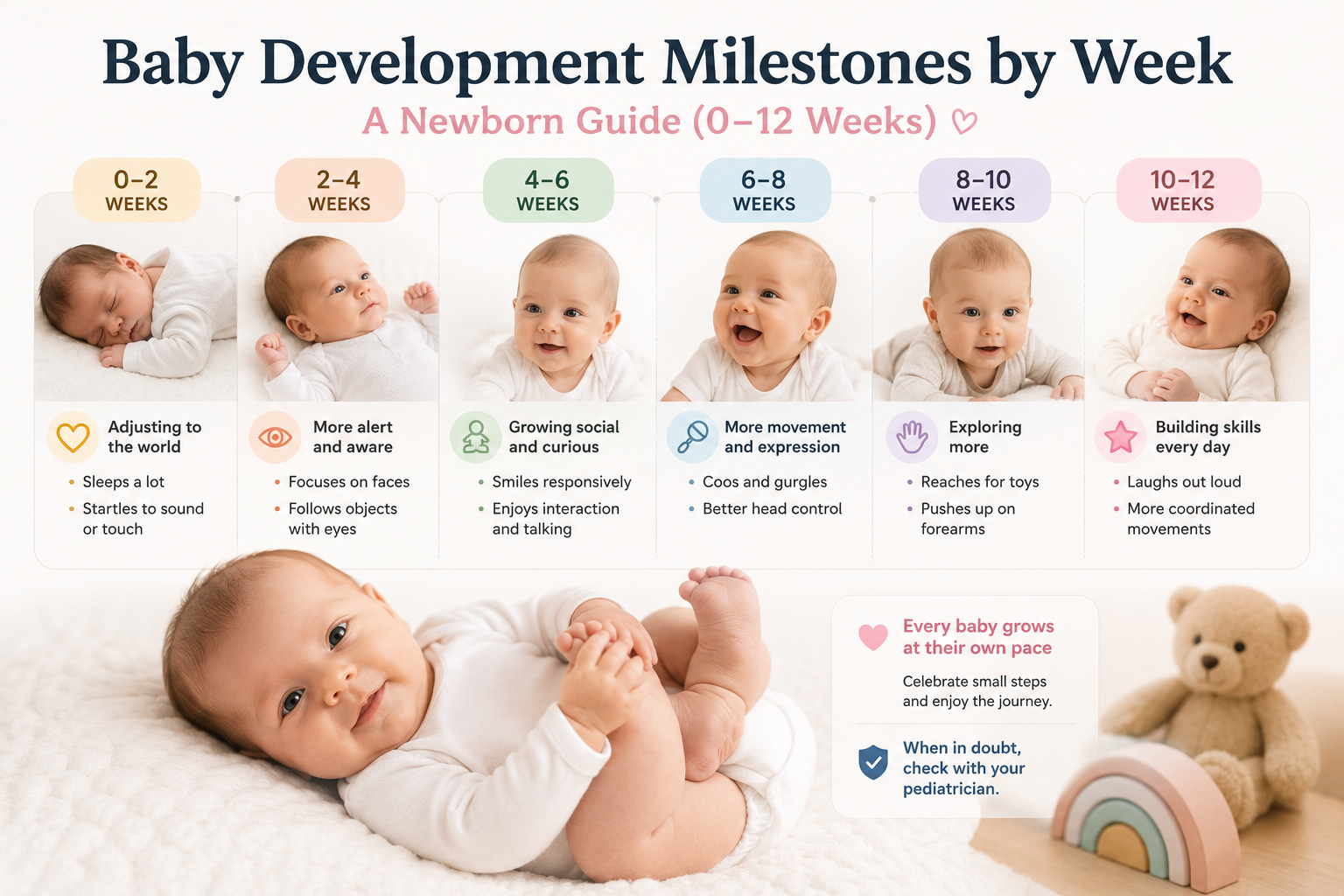
A baby’s vision develops rapidly during the first year of life. While newborns are not born with perfect eyesight, their visual abilities improve month by month through exposure, brain growth, and environmental interaction. Understanding the baby eye development timeline helps parents recognize what is normal from birth to one year and identify when to seek professional guidance.
How Developed Is a Baby’s Vision at Birth?
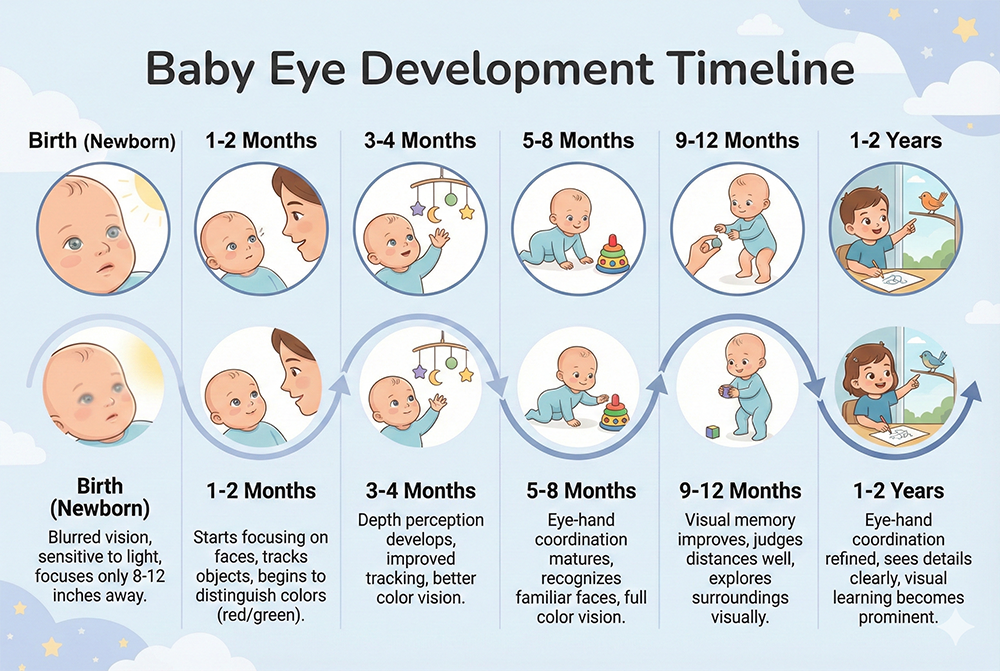
At birth, a baby’s vision is still immature. Newborns can see, but their world appears blurry. They are most comfortable focusing on objects that are about 8 to 12 inches away—approximately the distance between their face and a caregiver’s during feeding.
Newborn Vision Characteristics
- Blurry eyesight
- Sensitivity to bright light
- Preference for high-contrast patterns
- Limited color perception
0–1 Month: Light and Shadow Awareness
During the first month, babies mainly detect light, dark, and strong contrasts. Black-and-white patterns are easiest for them to see.
What to Expect
Babies may briefly focus on faces but cannot maintain steady eye contact for long periods.
2 Months: Improved Focus and Tracking
By two months, visual coordination improves. Babies begin tracking moving objects and may follow a caregiver’s face across their field of vision.
Early Social Vision
Around this time, babies may start smiling in response to familiar faces, reflecting growing visual and social development.
3 Months: Beginning Depth Perception
At three months, babies gain better control over eye movements. Eye alignment improves, and depth perception begins developing.
Color Recognition Expands
While newborns primarily see in black and white, by three months they can distinguish more colors, especially red and green.
4–5 Months: Hand-Eye Coordination
Around four to five months, vision and motor skills begin working together. Babies reach for objects they see and begin exploring their environment visually and physically.
Improved Depth Perception
Depth perception becomes stronger as both eyes learn to work together effectively.
6 Months: Sharper Vision
By six months, babies’ visual acuity improves significantly. Their eyesight becomes clearer, and they can see across the room.
Recognizing Familiar Faces
Babies easily recognize caregivers and may react differently to familiar versus unfamiliar faces.
7–9 Months: Advanced Visual Exploration
During this stage, visual skills support mobility milestones such as crawling.
Visual-Motor Integration
Babies use vision to guide hand movements, grasp objects, and judge distances more accurately.
10–12 Months: Near Adult-Like Vision
By one year, most babies have developed much sharper vision, although it may not yet be fully at adult levels. Depth perception, color vision, and coordination are significantly improved.
Visual Milestones at One Year
- Tracking fast-moving objects
- Recognizing objects at a distance
- Strong hand-eye coordination
When to Be Concerned About Baby Eye Development
While variation is normal, parents should consult a pediatrician if they notice persistent issues.
Signs That Require Evaluation
- Constant eye crossing after 4 months
- Lack of eye contact
- Extreme light sensitivity
- White reflection in the pupil
How to Support Healthy Eye Development
Simple activities can encourage healthy visual growth.
Practical Tips
- Provide high-contrast toys in early months
- Encourage tummy time to strengthen coordination
- Talk and make eye contact regularly
- Schedule routine pediatric checkups
The First Year Shapes Lifelong Vision
The first twelve months are critical for building strong visual pathways in the brain. By understanding the baby eye development timeline, parents can confidently support healthy growth from birth to one year.