
Are babies’ eyes fully developed at birth?
No—babies’ eyes and visual systems are not fully developed at birth. While the structures of the eye are present, a newborn’s vision is still immature because both the eyes (like the retina and focusing system) and the brain pathways that interpret what they see continue developing rapidly during the first year of life.
This is normal and expected. In fact, vision development is one of the biggest “behind-the-scenes” upgrades happening in infancy. Understanding what your baby can see (and when) can help you feel more confident, support healthy development, and recognize signs that warrant a check-in with your pediatrician or pediatric eye specialist.
How vision works: eyes + brain development
Vision isn’t just about the eyeballs. Your baby’s ability to see depends on a coordinated system:
- The cornea and lens focus light.
- The iris and pupil control how much light enters.
- The retina converts light into signals.
- The optic nerve carries signals to the brain.
- The visual cortex (in the brain) processes and interprets images.
At birth, many of these parts work, but they are not yet “fine-tuned.” The brain must learn to combine input from both eyes, interpret contrast, perceive depth, and control eye movements smoothly. This is why early vision looks blurry and why visual skills unfold in stages.
What can newborns see?
Newborn vision is blurry—and that’s normal
Newborns typically see best at a close range—roughly the distance between your face and your baby’s face during feeding and cuddling (about 8–12 inches / 20–30 cm). This close-range preference is biologically useful: it supports bonding and helps babies start learning faces.
They notice contrast more than color
Early on, babies are drawn to high-contrast patterns (like black-and-white shapes) because contrast is easier to detect than subtle color differences. Color vision develops over the first months as cone cells and brain pathways mature.
They may not track smoothly at first
It’s common for newborn eyes to look a little uncoordinated. Brief periods of crossing or drifting can happen in the early weeks as eye muscles and neural control mature. Consistent or worsening misalignment should be discussed with a clinician.
Which parts of the eyes are still developing?
Several components continue to mature after birth. Key areas include:
The retina and visual acuity
The retina’s light-sensing cells and their connections to the brain become more efficient over time. Visual acuity (sharpness) improves significantly in the first 6–12 months, with continued refinement into early childhood.
Focusing (accommodation)
The newborn lens can focus, but focusing control is immature. Babies gradually get better at shifting focus between distances.
Eye teaming and binocular vision
Using both eyes together—aligning them on the same target and blending images—is essential for depth perception. This “teamwork” strengthens across the first months and is a major reason early eye alignment matters.
Depth perception
True depth perception depends on coordinated binocular vision. It typically emerges as babies get better at tracking, focusing, and aligning both eyes—often becoming more noticeable in the second half of the first year.
Tear production
Many newborns don’t produce abundant tears right away. It’s common for babies to cry with little or no tears in the early weeks. Tear production usually increases over the first month or two.
Baby vision milestones: what to expect by age
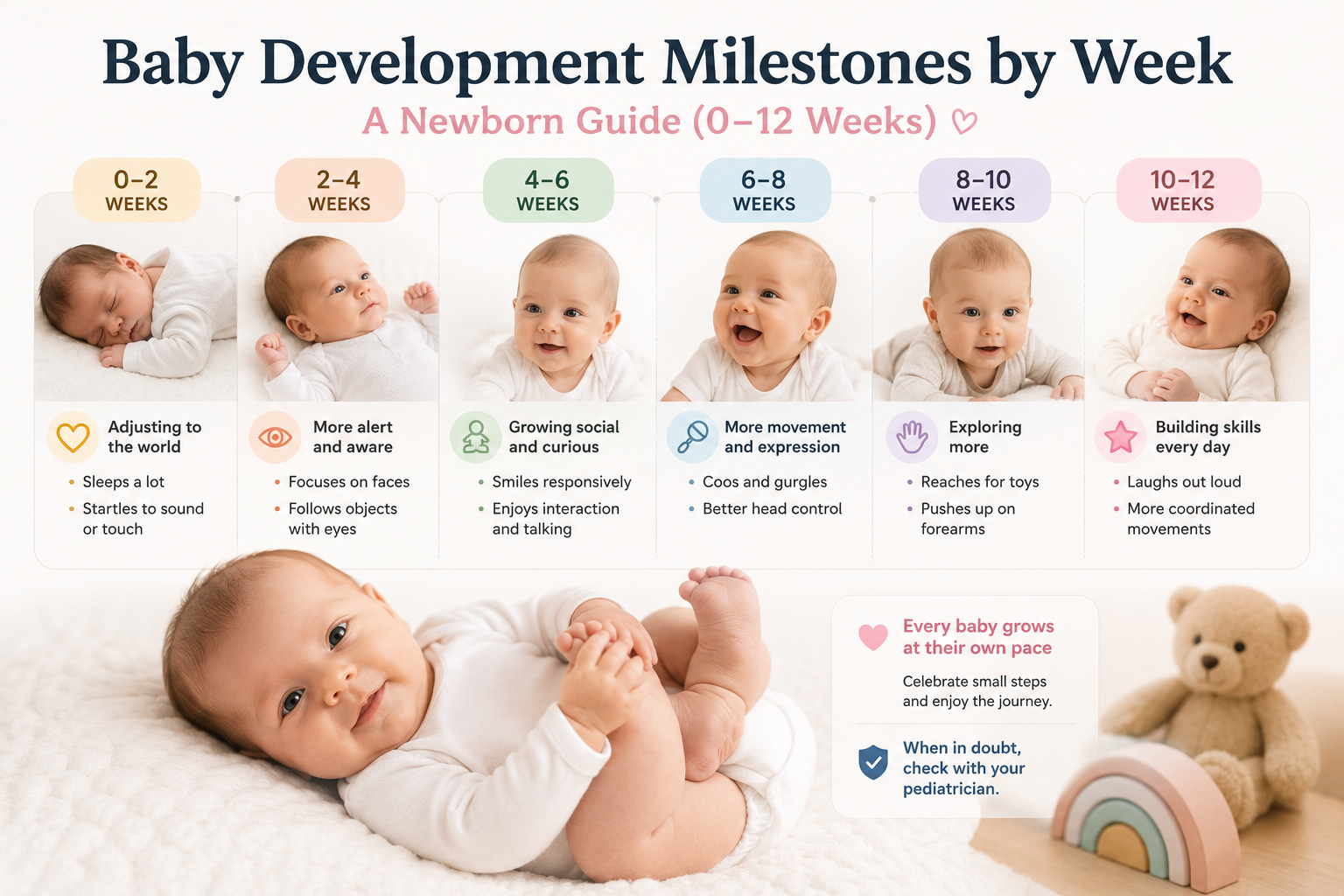
Every baby develops at their own pace, but the milestones below can help you understand typical patterns. If your baby was born early, it’s often more helpful to consider corrected age (age based on due date) for developmental expectations.
Birth to 1 month
- Prefers faces and high-contrast shapes up close
- Briefly looks at bright windows or lights
- Eye movements may be jerky; may appear cross-eyed at times
2 to 3 months
- More consistent eye contact
- Begins to track moving objects more smoothly
- Starts noticing hands and bringing them into view
4 to 6 months
- Better tracking in all directions
- Improved hand-eye coordination (reaching for what they see)
- More interest in colorful objects; stronger visual attention
7 to 9 months
- Stronger depth perception
- Looks for partially hidden objects (early object permanence)
- Uses vision to guide crawling and exploring
10 to 12 months
- More accurate distance judging
- Enjoys picture books; recognizes familiar people across a room
- Uses visual cues in social games (peekaboo, waving)
Toddler years (1 to 3 years)
- Continued refinement of sharpness, focusing, and depth perception
- Visual-motor skills grow quickly (stacking, scribbling, puzzles)
- Vision screening becomes increasingly important as kids become more verbal and cooperative
How pediatric vision is checked: screening and eye exams
Most babies have their eyes assessed in routine pediatric visits. Clinicians look at:
- Red reflex (a reflection test that can flag cataracts or other concerns)
- Eye alignment and movement
- Pupil responses
- General visual behavior (tracking, fixation, attention)
When does a baby need a full eye exam?
Some babies need a more detailed evaluation by a pediatric ophthalmologist or eye care professional, especially if they have risk factors such as:
- Prematurity or low birth weight
- Family history of childhood eye disease (lazy eye/amblyopia, strabismus, high prescription, congenital cataracts)
- Abnormal red reflex
- Noticeable or persistent eye misalignment
- Developmental delays or certain medical conditions linked to vision problems
Practical ways to support healthy vision development
You don’t need fancy tools to encourage your baby’s visual development. Simple, responsive interactions are powerful.
1) Offer face-to-face time every day
Your face is one of your baby’s favorite “visual toys.” Hold your baby close during feeding and cuddles, make gentle eye contact, and talk or sing. This supports both visual attention and social development.
2) Use high-contrast patterns in the early months
In the newborn stage, choose simple patterns—black-and-white cards, bold shapes, or high-contrast book pages. Place them about 8–12 inches away and move them slowly side to side to encourage tracking.
3) Move toys slowly and give time to focus
Babies need extra time to lock onto an object. Use slow, predictable movements. If your baby looks away, pause and try again later.
4) Encourage “tummy time” (when awake and supervised)
Tummy time helps babies lift their heads, strengthen neck and shoulder muscles, and change their visual perspective. These motor gains support eye tracking and hand-eye coordination.
5) Provide a variety of safe viewing distances
As your baby grows, let them look at objects near and far: a toy in hand, your face across the room, and a mobile above (placed safely out of reach). Variety encourages focusing flexibility.
6) Use natural light thoughtfully
Daylight helps regulate sleep-wake cycles and offers rich visual input. Aim for comfortable, indirect light. Avoid shining bright lights directly into your baby’s eyes.
7) Prioritize overall health: nutrition, sleep, and well-child visits
Healthy vision development is tied to overall growth. Keep up with routine pediatric care, and if breastfeeding or formula feeding, follow your pediatrician’s guidance for adequate nutrition. For babies starting solids around 6 months (as advised), nutrients like vitamin A, omega-3 fatty acids (DHA), zinc, and lutein support eye health as part of a balanced diet.
Common newborn eye concerns (and what’s normal)
Crossed eyes or wandering eyes
Occasional crossing or drifting can be normal in the first weeks as the eye muscles and coordination mature. However, persistent eye misalignment (especially beyond about 3–4 months) should be evaluated because early treatment can protect developing vision.
Watery eyes or goopy discharge
Many babies have a partially blocked tear duct, leading to tearing or mild crusting—often worse with wind or cold. Gentle cleaning with warm water can help. If there is significant redness, swelling, thick yellow/green discharge, or your baby seems uncomfortable, contact your pediatrician to rule out infection.
Light sensitivity
Some newborn sensitivity can be normal. But pronounced light sensitivity, cloudy-looking eyes, or excessive tearing may need prompt assessment.
Different-sized pupils or unusual eye appearance
Small differences can occur, but noticeable asymmetry, a droopy eyelid, a white/gray pupil reflection, or a consistently cloudy cornea should be checked urgently.
Warning signs: when to call your pediatrician promptly
Trust your instincts—if something feels off, it’s worth asking. Seek medical advice if you notice:
- No eye contact or no interest in faces by 8–12 weeks
- No tracking of moving objects by about 3 months
- Persistent eye crossing or drifting beyond 3–4 months
- Constant eye shaking (nystagmus) or very jerky eye movements
- White, gray, or absent red reflex in photos (a white glow in the pupil instead of “red eye”)
- One eye consistently turns in/out/up/down
- Frequent eye rubbing when not tired, or signs of discomfort
- Significant redness, swelling, or discharge
- Difficulty seeing as your baby becomes mobile (bumping into things beyond typical clumsiness)
Premature babies and eye development
If your baby was born prematurely, their eye development timeline may differ. Premature infants can be at risk for certain eye conditions, including retinopathy of prematurity (ROP), which requires specialized screening based on gestational age and birth weight. If your baby was in the NICU, the care team typically sets up an eye screening schedule. Keep all recommended appointments—early detection is key.
Will my baby’s eye color change?
Possibly. Many babies—especially those with lighter-colored eyes—experience eye color changes in the first 6–12 months as melanin (pigment) increases in the iris. This is separate from vision development but often surprises parents. Darker eyes may change less noticeably, but subtle shifts can still occur.
Do screens affect baby vision?
Research continues to evolve, but most pediatric guidance emphasizes that babies learn best through real-world interaction. For infants, screen time can displace face-to-face time, movement, and sleep—all of which support healthy development. If screens are used (for example, video chatting with family), keep it brief, interactive, and avoid screens close to bedtime. Also keep screens at a comfortable distance and never place a device directly in front of a baby’s face.
How to create a vision-friendly daily routine (simple and doable)
If you’d like an easy plan, try building these habits into your day:
- Morning: Open curtains for natural light; do a few minutes of face-to-face talking.
- Playtime: 1–2 short tracking games with a high-contrast card or toy moved slowly.
- Floor time: Supervised tummy time with a simple toy placed just within viewing range.
- Outings: Let your baby look at trees, shadows, and changing light (avoid direct sun in eyes).
- Evening: Dim lights as bedtime approaches to support sleep rhythms.
The bottom line for parents
Babies are born with eyes that are structurally present but still developing in function. In the early weeks, vision is blurry and best at close range, with rapid progress in tracking, focusing, and eye teaming throughout the first year. The most helpful supports are simple: loving face time, age-appropriate visual play, tummy time, good nutrition, and keeping routine pediatric visits.
If you notice red flags—especially persistent eye misalignment, lack of tracking, or unusual pupil reflections—reach out promptly. Early evaluation can make a meaningful difference, and most concerns are manageable when caught early.