Why Baby Vision Development Matters
Your baby is born with eyes that can see, but the brain’s ability to interpret what the eyes take in develops over time. Vision development is closely tied to brain growth, movement skills (like reaching and crawling), and social-emotional bonding (like recognizing your face and reading expressions). Understanding typical vision milestones can reassure you when things look “normal,” and help you spot early signs that may need a pediatrician or pediatric eye specialist.
Good news: Most babies follow a predictable pattern of visual development. There’s also a wide range of normal—especially in the first few months—so a “chart” is best used as a guide, not a test your baby must pass on an exact date.
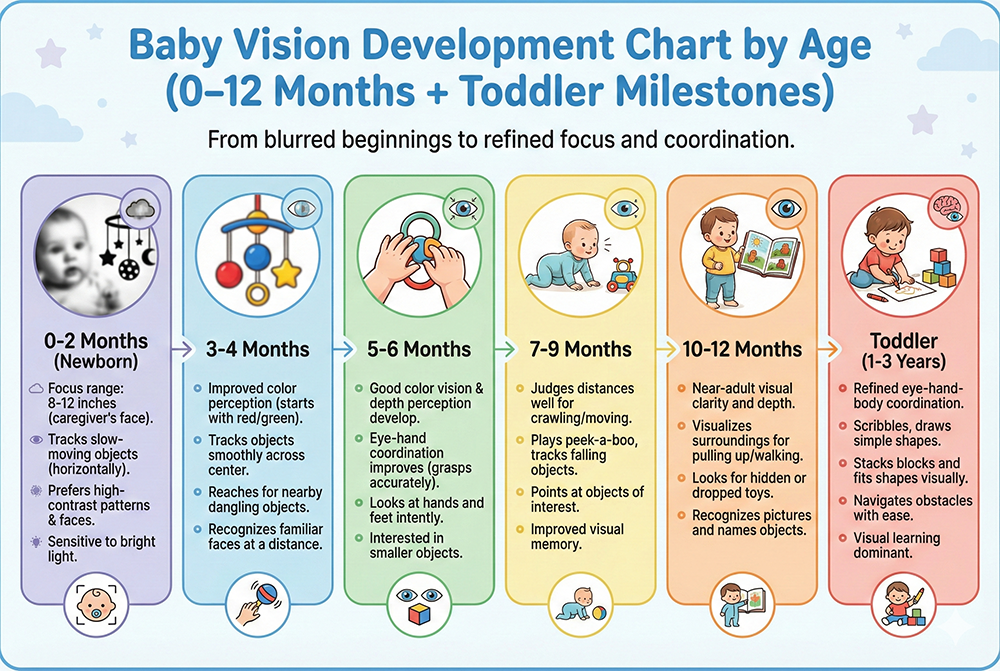
Baby Vision Development Chart by Age
Below is an evidence-based baby vision development chart by age. Milestones describe what many babies can do around that time and what you might notice at home.
Birth to 1 Month: Blurry, Close-Up Vision
What baby sees: Newborn vision is blurry. Babies see best at close range—about 8–12 inches (20–30 cm), roughly the distance to your face during feeding.
- Common milestones: Briefly focuses on faces, prefers high-contrast patterns, may look at lights.
- What you may notice: Occasional eye crossing is common early on as eye muscles strengthen.
Helpful tips: Hold your face close during cuddles and feeds, use high-contrast black-and-white patterns, and keep lighting soft but adequate.
2 Months: Better Tracking and Social Looking
What baby sees: Improved ability to focus; begins tracking objects more smoothly.
- Common milestones: Tracks a moving face or toy briefly, looks at caregiver’s eyes, increased interest in contrast.
- What you may notice: More steady eye contact during calm, alert periods.
Helpful tips: Slowly move a toy side-to-side about 8–12 inches from baby’s face. Pause if baby looks away—looking away is a normal “break.”
3 Months: Smoother Tracking and Early Hand-Eye Coordination
What baby sees: Improved clarity, better tracking, growing interest in faces and objects.
- Common milestones: Follows moving objects with eyes, recognizes familiar faces at close range, watches hands.
- What you may notice: Baby may start swiping at toys while watching them.
Helpful tips: Offer a simple rattle or soft toy within reach during supervised play. Encourage “watch and reach” games.
4 Months: Depth Perception Begins to Develop
What baby sees: Better color vision and improved coordination between both eyes.
- Common milestones: Tracks in a wider arc, brings hands together, looks from object to caregiver and back.
- What you may notice: More accurate reaching and grasping.
Helpful tips: Provide toys at different distances during tummy time to encourage focusing shifts. Use safe mirrors for visual interest.
5 Months: Reaching Accuracy Improves
What baby sees: Stronger binocular vision (both eyes working together), improving depth cues.
- Common milestones: Reaches for objects with better aim, looks across a room, watches drops and rolling objects.
- What you may notice: Baby enjoys watching you move around and may visually “track” you.
Helpful tips: Roll a ball slowly and let baby watch it travel. Offer toys of different textures and colors.
6 Months: Depth Perception and Distance Vision Take a Leap
What baby sees: Many babies can see farther and coordinate eyes efficiently.
- Common milestones: Focuses at various distances, tracks fast-moving objects better, recognizes familiar people from farther away.
- What you may notice: Strong interest in environment; visual curiosity increases as mobility begins.
Helpful tips: Play peekaboo, place toys slightly out of reach to motivate movement, and narrate what baby is seeing (“That’s the blue cup!”).
7–8 Months: Visual Memory and Searching Skills
What baby sees: Stronger visual attention and memory; better ability to spot partially hidden objects.
- Common milestones: Looks for a toy that fell, inspects objects closely, may recognize familiar people across a room.
- What you may notice: Baby may become interested in small details (labels, patterns).
Helpful tips: Play simple hide-and-find games with a toy under a cloth. Offer board books with clear pictures.
9–10 Months: Active Visual Exploration With Mobility
What baby sees: Improved depth perception helps with crawling, cruising, and navigating obstacles.
- Common milestones: Judges distances better, watches your gestures, looks where you point, scans for objects.
- What you may notice: Baby visually checks surfaces before moving—especially near stairs or edges.
Helpful tips: Baby-proof well (gates on stairs, furniture anchors). Create safe “obstacle courses” with pillows for supervised play.
11–12 Months: Near-Adult-Like Coordination (Still Developing)
What baby sees: Many babies have strong eye teaming and hand-eye coordination, though fine visual skills continue developing for years.
- Common milestones: Recognizes familiar faces easily, points at pictures, enjoys looking at books, throws objects while watching where they go.
- What you may notice: Baby may notice tiny crumbs or small objects—another reason to keep floors clear.
Helpful tips: Encourage pointing to pictures in books, stacking games, and simple shape sorters.
12–24 Months (Toddler Overview): Visual-Motor Skills Expand
What toddlers work on: Visual attention, tracking, depth perception, and visual-motor integration (eyes guiding hands) grow rapidly with walking, climbing, and early drawing.
- Common milestones: Enjoys scribbling, turns pages, recognizes pictures, begins matching shapes, watches moving objects outdoors.
Helpful tips: Provide chunky crayons, balls to throw/roll, and outdoor play to support distance vision and tracking.
What’s “Normal” vs. What’s Not: Understanding the Range
Milestones vary because babies develop at different rates, and vision skills depend on more than eyesight alone—alertness, temperament, muscle control, and overall development all play roles. A baby might not track well one day simply because they’re tired, hungry, or overstimulated.
That said, some patterns deserve prompt attention. Trust your instincts—if something consistently seems off, it’s worth discussing with your pediatrician.
Red Flags: When to Talk to the Pediatrician (or a Pediatric Eye Doctor)
Contact your child’s healthcare provider if you notice any of the following, especially if persistent:
- No steady eye contact or no interest in faces by around 8–12 weeks.
- Not tracking moving objects by around 3–4 months.
- One eye consistently turning in/out after 4 months (intermittent crossing can be normal earlier; persistent misalignment later should be evaluated).
- Constant eye jiggling (nystagmus) or eyes that appear to shake.
- White, cloudy, or gray pupil in photos or in certain lighting (not just “red-eye”).
- Strong, persistent light sensitivity or frequent squinting.
- Excessive tearing with redness/discharge, or ongoing crusting.
- Droopy eyelid that covers part of the pupil.
- Noticeable difference between eyes (one eye doesn’t seem to see as well, or one pupil is a different size).
- Regression: baby stops doing a visual skill they previously had.
Important: Early detection matters. Some eye conditions are treatable, and the developing brain is most responsive to treatment in the first years of life.
What Influences Baby Vision Development?
1) Brain Development and Sensory Experience
Vision is a brain-based skill. Your baby’s brain builds connections through repeated experiences—looking at faces, tracking toys, reaching, and moving through space.
2) Eye Teaming and Focusing Skills
Babies must learn to align both eyes on the same target (binocular vision), focus clearly (accommodation), and coordinate eye movements (tracking). These skills develop gradually and improve with practice.
3) Health Factors
Prematurity, certain genetic conditions, and some medical issues can affect eye health and vision development. If your baby was born early or had complications, follow your pediatrician’s recommended eye screening schedule.
4) Environment and Daily Habits
Daily interaction supports visual learning: face time, floor play, safe movement, and age-appropriate toys. You don’t need expensive tools—simple, consistent engagement is powerful.
Practical Ways to Support Healthy Vision (By Age)
0–3 Months: Build Focus and Comfort
- Use close-up face time: Speak and smile during feeds and diaper changes.
- Try high-contrast visuals: Simple black-and-white cards or patterns.
- Keep play short and calm: Newborns tire quickly; stop when baby looks away.
4–6 Months: Encourage Tracking and Reaching
- Do “slow follow” games: Move a toy left/right and up/down.
- Offer safe mirrors: Babies love faces—even their own reflection.
- Rotate toys: Too many options can overwhelm; a few well-chosen items are best.
7–9 Months: Support Visual Problem-Solving
- Play hide-and-seek with objects: Partly cover a toy and let baby find it.
- Read picture books: Point to images and name them.
- Give space to move: Crawling and cruising strengthen depth perception and coordination.
10–12+ Months: Build Visual-Motor Skills
- Stacking and sorting toys: Great for eye-hand coordination.
- Ball play: Rolling, tossing, and chasing a ball supports tracking.
- Outdoor time: Looking at distant objects supports distance vision and overall development.
Common Parent Questions and Myths (Quick Clarifications)
“Is it normal for my newborn’s eyes to cross?”
Occasional crossing can be common in the first couple of months as eye coordination develops. Persistent or worsening misalignment after about 4 months should be evaluated.
“Do babies see in color?”
Color vision develops over the first months of life. Babies tend to prefer high-contrast visuals early on, with improved color discrimination as the visual system matures.
“Will screens damage my baby’s eyes?”
Screens don’t typically “damage” eyes directly, but heavy screen exposure can displace important experiences—face-to-face interaction, play, and sleep. For infants and young toddlers, prioritize real-world play and caregiver interaction.
Doctor Visits and Vision Screening: What to Expect
Routine well-child visits usually include basic eye and vision checks (like red reflex, eye alignment, and tracking) and questions about visual behavior. Formal vision testing becomes more feasible as children get older, but concerns at any age can warrant a referral to a pediatric ophthalmologist or pediatric optometrist.
Tip for parents: Bring notes to appointments. Mention what you see at home: “Doesn’t track,” “one eye turns,” “squints at light,” or “doesn’t recognize us across the room.” Short videos can also be helpful.
How to Use This Vision Chart Without Stress
Try viewing milestones as a conversation starter, not a pass/fail checklist:
- Look for progress over weeks, not perfection in a day.
- Consider the whole baby: sleep, feeding, temperament, and gross motor development affect attention and tracking.
- When in doubt, check it out: If something worries you, asking early is a strength—not an overreaction.
Internal Linking Suggestions (for a Stronger Parent Resource Hub)
- Link to “Tummy Time by Age: A Parent’s Guide” (supports visual-motor development).
- Link to “Baby Milestones by Month” (context for overall development).
- Link to “Baby Safe Sleep Tips” (sleep impacts attention and development).
- Link to “Best High-Contrast Toys for Newborns” (practical tools for early months).
- Link to “When to Call the Pediatrician: Newborn Concerns” (safety and reassurance).
Takeaway: A Gentle Timeline for Growing Eyes
Baby vision development is a beautiful, gradual process: from blurry close-up focus in the newborn stage to increasingly precise tracking, depth perception, and visual-motor skills by the end of the first year. Your everyday interactions—talking, smiling, reading, playing on the floor, and exploring safely—provide exactly the kind of input your baby’s brain uses to build strong visual pathways.
If you notice persistent red flags (like constant eye turning, no tracking by 3–4 months, or unusual pupil appearance), reach out to your pediatrician promptly. Early support can make a meaningful difference, and most parents feel relieved after getting clear guidance.