
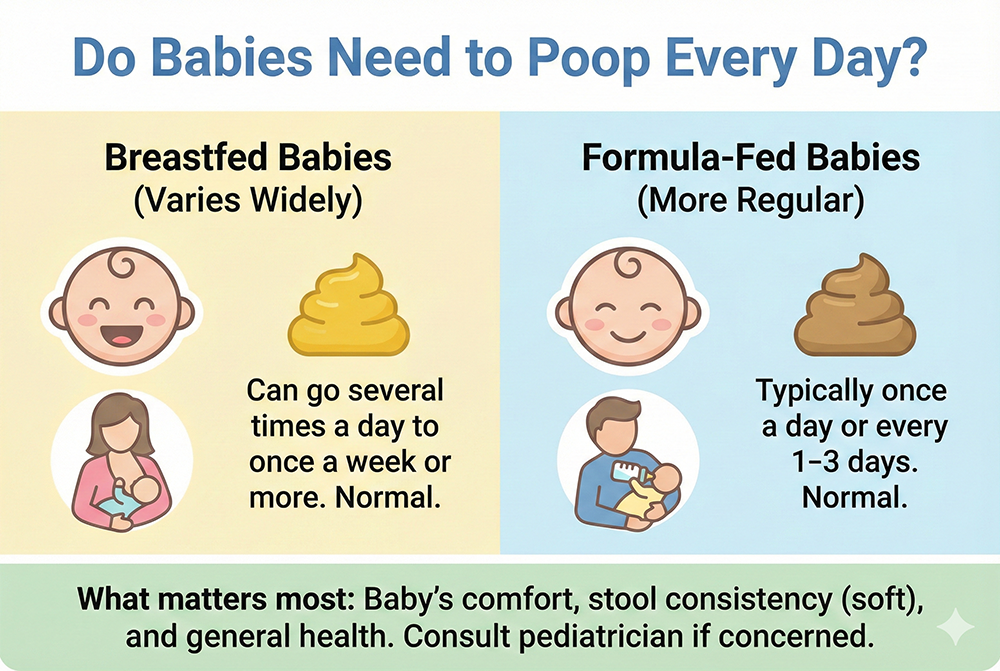
Do babies need to poop every day?
Not necessarily. Many healthy babies do not poop every day—especially after the newborn period. What matters most is your baby’s overall well-being: steady feeding, comfortable belly, normal growth, and stools that are soft (not hard, pellet-like) when they do happen.
Baby bowel habits can vary widely. Some babies poop after almost every feeding, while others go every other day—or even less often—without any problem. This range is considered normal because a baby’s digestive system is still maturing, and breast milk or formula is digested differently depending on age, feeding style, and individual gut motility.
If you’re wondering whether your baby is constipated or if infrequent pooping is normal, you’re not alone. Below you’ll find evidence-based guidance on typical poop frequency, what influences it, signs of constipation versus normal “waiting,” and practical ways to support comfortable digestion.
What’s “normal” baby poop frequency by age
There isn’t one perfect schedule for baby poop. Normal ranges are broad, and patterns often change quickly in the first year.
Newborns (0–4 weeks)
In the earliest weeks, many newborns poop frequently—often several times per day. It’s common for babies to stool after feeds because the gastrocolic reflex (the body’s natural “eat → digest → poop” signal) can be strong in newborns.
- Breastfed newborns: Often poop multiple times per day in the first weeks.
- Formula-fed newborns: May poop less frequently than breastfed babies, but still often daily.
In this stage, your pediatrician will pay special attention to whether your baby has passed meconium (the dark, tarry first stool) within the first 24–48 hours of life, as delays can signal a medical issue.
1–2 months
This is when many parents get surprised. As breastfeeding becomes established and babies grow, breastfed babies may poop less often—sometimes every few days. Breast milk is highly digestible, and some babies absorb most of it, leaving less waste to pass.
Formula-fed babies often continue to poop more regularly (commonly once a day or every other day), though variation remains normal.
3–6 months
Many babies settle into a pattern—though it can still change with growth spurts, illness, travel, or changes in routine. If your baby is exclusively milk-fed, pooping every day is not required as long as stools remain soft and your baby is comfortable.
6–12 months (starting solids)
When solids are introduced, poop typically becomes:
- More formed and pasty or thicker
- Stronger smelling
- More variable in frequency
Some babies poop more often with solids; others become more prone to constipation during this transition—especially if their diet skews toward low-fiber foods or they aren’t taking enough fluids.
Breastfed vs. formula-fed: why poop patterns differ
Feeding type is one of the biggest factors behind baby poop frequency.
Breastfed babies
Breast milk contains an ideal balance of nutrients and bioactive components that support digestion. Because it’s efficiently used by the body, there may be less leftover to eliminate. It’s not unusual for an otherwise healthy breastfed baby older than a few weeks to poop:
- Several times a day, or
- Once every few days, or
- Occasionally even less often
As long as the stool is soft and your baby is feeding well and growing, infrequent pooping can be normal.
Formula-fed babies
Formula tends to produce stools that are a bit firmer and may move through the gut at a different pace. Many formula-fed babies poop at least once a day, but going every other day can also be normal if stools are soft and passing is not painful.
Frequency vs. constipation: what matters most
Parents often worry about the number of days between bowel movements. Clinically, constipation is less about how often your baby poops and more about how difficult or uncomfortable it is, plus stool consistency.
Signs your baby may be constipated
- Hard, dry stools (pellets, pebbles, or very thick clay-like stool)
- Straining with pain (crying in discomfort, not just normal grunting)
- Streaks of blood on the stool or diaper (often from a small anal fissure caused by hard stool)
- Swollen or firm belly paired with discomfort
- Decreased appetite or seeming “full” quickly
- Fewer wet diapers (possible dehydration)
Signs it’s likely normal
- Soft stools when they happen
- Normal feeding and wet diapers
- Steady growth and usual energy/alertness
- Some straining/grunting but the stool is soft and baby calms afterward
Why babies strain and grunt (and still aren’t constipated)
Many young babies look like they’re struggling to poop: they turn red, scrunch their face, grunt, and kick. This can be alarming, but it’s often a normal developmental phase sometimes referred to as infant dyschezia.
In simple terms, babies are learning to coordinate two actions at once:
- Relaxing the pelvic floor/anal sphincter
- Increasing abdominal pressure to push
During this learning period, they may strain and cry for several minutes, but the stool that comes out is soft. That pattern is typically not constipation and often improves on its own as coordination matures.
What baby poop should look like (and what changes are normal)
Color and texture vary depending on age and diet. Here are common, generally normal patterns:
Typical textures
- Newborn meconium: black/green, sticky
- Transition stool: greenish-brown, less sticky
- Breastfed stool: mustard-yellow, seedy or creamy; often loose
- Formula stool: tan/yellow/brown; thicker like peanut butter
- After solids: thicker, formed, and more varied
Typical colors
Shades of yellow, brown, and green can be normal. Some foods (like spinach, peas, blueberries, beets) can change stool color.
Call your pediatrician promptly if you see:
- White or clay-colored stool (can signal a bile flow problem)
- Black stool after the meconium phase (can indicate bleeding higher in the GI tract)
- Red blood that is more than a small streak or is recurring
Common reasons a baby may not poop every day
If your baby seems fine but poops less often, one (or more) of these may be at play:
- Breast milk is efficiently digested (especially after 4–6 weeks)
- Normal individual variation in gut motility
- Growth spurts (temporary changes in intake and digestion)
- Starting solids (more formed stool, sometimes slower transit)
- Low fluid intake during illness or heat
- Diet composition (more binding foods like rice cereal, bananas, cheese, and fewer fruits/vegetables)
- Routine changes such as travel or schedule disruption
How long can a baby safely go without pooping?
There’s no single “safe” number of days that applies to every baby. Context matters: age, feeding type, stool consistency, and overall behavior.
- Young breastfed babies (after the first month): going a few days without pooping can be normal if stools remain soft and baby is thriving.
- Formula-fed babies: infrequent stools can still be normal, but constipation is slightly more common due to firmer stools.
- After solids: longer gaps plus hard stools suggest constipation rather than normal variation.
If your baby is comfortable and producing normal wet diapers, the body may simply be taking longer to build up enough stool volume to pass.
Practical tips to help a baby poop (gentle, evidence-based)
If your baby seems uncomfortable, stools are firm, or the transition to solids has slowed things down, these gentle strategies are often helpful. Choose what fits your baby’s age and feeding stage.
1) Check feeding and hydration
- Milk intake matters: Underfeeding can reduce stooling and lead to dehydration, which hardens stools.
- Wet diapers are a key clue: If wet diapers are down, talk to your pediatrician promptly.
2) Try “bicycle legs” and tummy massage
For many babies, simple movement helps move gas and stool along:
- Gently move your baby’s legs in a cycling motion for 1–2 minutes.
- Massage the belly in small clockwise circles (gentle pressure).
- Offer supervised tummy time if your baby enjoys it.
3) Warmth can relax muscles
A warm bath can help relax the abdominal and pelvic muscles, which may make pooping easier—especially during the learning-to-coordinate phase.
4) If your baby is on solids: add “P” fruits and fiber-friendly foods
Once your baby is developmentally ready for solids (often around 6 months, per pediatric guidance), certain foods can soften stool:
- Prunes (puree, or prune juice diluted as advised)
- Pears
- Peaches
- Plums
- Peas
- Oatmeal instead of rice cereal
Foods that can be more binding include rice cereal, large amounts of banana, and cheese. You don’t necessarily need to avoid them, but balancing them with fruit/veg and fluids can help.
5) Offer appropriate fluids (age-dependent)
For babies under 6 months, breast milk or formula typically provides needed hydration. For older babies on solids, small amounts of water may be appropriate with meals based on your pediatrician’s advice.
Do not give honey to babies under 12 months, and avoid herbal teas or home remedies unless a clinician recommends them.
6) Avoid rectal stimulation unless instructed
Thermometers, cotton swabs, or frequent stimulation can irritate delicate tissue and may create dependence. If your pediatrician recommends a specific approach (like an occasional glycerin suppository in select cases), follow their dosing and frequency guidance carefully.
When to call the pediatrician (and when it’s urgent)
Trust your instincts. If something feels off, it’s appropriate to check in.
Call your baby’s clinician soon if:
- Your baby has hard stools or seems in pain when pooping
- There is recurrent blood in the stool or diaper
- Your baby is vomiting, especially if it’s persistent
- Your baby has a distended belly with discomfort
- You notice poor feeding or fewer wet diapers
- Constipation begins after starting solids and doesn’t improve with diet adjustments
Seek urgent care now if you notice:
- Bilious (green) vomiting
- Severe abdominal distension or extreme lethargy
- Refusal to feed with signs of dehydration (very few wet diapers, dry mouth, sunken soft spot)
- Black stools (after the newborn meconium period) or large amounts of blood
Special situations that deserve extra attention
Most poop-frequency concerns are normal variation, but some situations require closer monitoring.
Newborn not pooping in the first 24–48 hours
This warrants prompt medical evaluation to rule out issues such as obstruction or certain congenital conditions.
Very hard stools in a young baby
Hard stools are not typical for exclusively breastfed newborns. If your baby is very young and passing hard stools, talk to your pediatrician to evaluate feeding adequacy, hydration, and other causes.
Constipation after switching formulas
Some babies react to changes in formula type with temporary stool changes. If constipation persists, consult your pediatrician before switching again, as frequent changes can sometimes worsen tummy troubles.
Suspected cow’s milk protein allergy (CMPA) or intolerance
CMPA more commonly causes blood/mucus in stool, diarrhea, or fussiness, but bowel changes can vary. If you’re seeing blood, significant eczema, or persistent GI symptoms, medical guidance is important.
How to track poop without spiraling
It’s easy to worry, especially when you’re sleep-deprived. A simple check-in can help you focus on the most meaningful signs:
- Comfort: Is baby generally content between feeds?
- Consistency: Are stools soft or hard?
- Wet diapers: Are they peeing regularly?
- Growth: Is weight gain on track at checkups?
- Pattern changes: Was there a recent switch (solids, formula, illness, travel)?
If the answers are reassuring, poop frequency alone is rarely a problem.
Key takeaways for parents
Babies don’t need to poop every day to be healthy. Many breastfed babies, in particular, may go several days between bowel movements after the first month. Look at the whole picture: your baby’s comfort, growth, hydration, and stool softness. When constipation signs appear—hard stools, pain, blood, swelling, vomiting, poor feeding—reach out to your pediatrician for tailored guidance.