One of the most common questions parents ask after leaving the newborn stage is how often should a 2-month-old baby be fed. While questions such as “how often should a 1-month-old baby be fed” and “how often should a 40-day-old baby be fed” are more common in the early weeks, by the second month, feeding intervals, breastfeeding duration, and formula amounts start to become more predictable. Still, every baby is unique, and all information provided here is for general guidance only; always follow your pediatrician’s recommendations regarding your baby’s health.
Feeding a 2-month-old baby is one of the most researched topics for parents, whether the baby is breastfed, formula-fed, or combination-fed. Searches such as “how often should a 2-month-old baby be fed,” “how often does a 2-month-old baby get hungry,” and “how long does a 2-month-old baby nurse” become more frequent as feeding routines begin to settle. At this stage, the baby’s stomach capacity increases, sucking strength improves, and the time between feedings may gradually lengthen. However, the healthiest approach is to focus on hunger cues rather than strict schedules and to monitor steady weight gain.
For breastfed babies, feeding frequency at 2 months is usually every 2.5–3 hours, while for formula-fed babies this interval may extend to 3–4 hours. Parents also frequently ask, “How long can a 2-month-old baby go without feeding at night?” Although night feeding intervals may lengthen slightly for babies gaining weight well, prolonged hunger should still be avoided. Questions such as how many milliliters of formula a 2-month-old baby should drink, how long they should nurse, or how often they should be fed do not have one single answer. The most accurate evaluation should be based on growth charts, daily diaper output, and pediatric checkups.
How Often Does a 2-Month-Old Baby Get Hungry?
There is no single answer to how often does a 2-month-old baby get hungry?, but generally, babies at this age feel hungry about every 3 hours during the day. Some babies may want to feed every 2–2.5 hours, while others may go 3–3.5 hours between feedings. Since breast milk is digested quickly, it is normal for exclusively breastfed babies to feel hungry more often.
- Breastfed 2-month-old baby: usually every 2.5–3 hours
- Combination-fed baby (breast milk + formula): about every 3 hours
- How often should formula-fed babies be fed? Typically every 3–4 hours
Instead of fixed feeding times, evaluating both hunger cues and weight gain together is the healthiest approach for a 2-month-old baby.
How Often Should a 2-Month-Old Baby Be Fed?
As a general guideline, how often should a 2-month-old baby be fed can be answered as every 2.5–3 hours during the day and every 3–4 hours at night. This interval may vary depending on the baby’s:
- Weight gain
- Daytime activity level
- Length of nighttime sleep
- Whether they are breastfed or formula-fed
While more frequent feedings are common in the first month, some babies naturally begin to extend the time between feedings by the second month.
How Long Can a 2-Month-Old Baby Go Without Feeding at Night?
The most important factor when answering how long can a 2-month-old baby go without feeding at night? is the baby’s weight gain and overall health. For a healthy baby with adequate weight gain:
- Night feeding intervals should generally not exceed 4 hours.
- For premature babies or those with borderline weight gain, shorter intervals (2–3 hours) are recommended.
Some babies may start sleeping for longer stretches around 2 months. Even then, it is important to consult your pediatrician before allowing very long periods without feeding.
How Often Should a 2-Month-Old Baby Be Breastfed?
The question how often should a 2-month-old baby be breastfed? is especially common among nursing parents. Breastfeeding is usually planned as:
- During the day: every 2–3 hours
- At night: every 3–4 hours
These are average intervals. During growth spurts, babies may want to nurse much more frequently, which is a natural way for the body to increase milk supply.
How Long Does a 2-Month-Old Baby Nurse?
The answer to “How long does a 2-month-old baby nurse?” varies from baby to baby. Nursing duration depends on sucking strength, latch quality, and milk flow.
- Average nursing time: about 10–20 minutes per breast
- Some babies feed effectively in 5–7 minutes, while others take longer
Therefore, it is difficult to give an exact number of minutes. What matters most is active swallowing during feeding, the baby appearing satisfied afterward, and consistent weight gain.
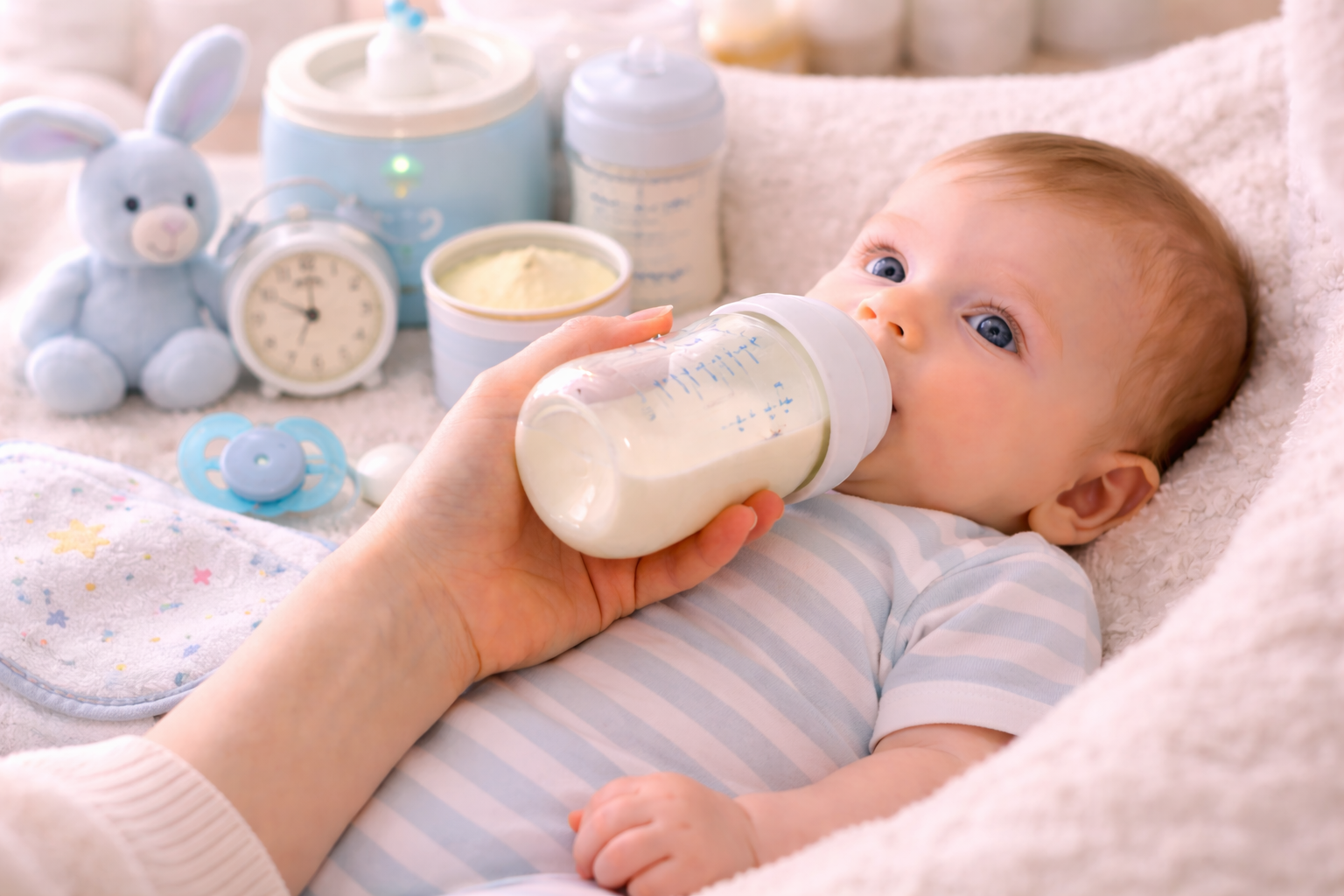
How Often Should a 2-Month-Old Baby Drink Formula?
For babies who are exclusively formula-fed or receive formula in addition to breast milk, how often should a 2-month-old baby drink formula? is important due to digestion time. Since formula digests more slowly than breast milk:
- Feeding every 3–4 hours is generally recommended.
- If the baby experiences frequent vomiting, irritability, or poor weight gain, intervals should be reassessed with a pediatrician.
How Many ml of Formula Does a 2-Month-Old Baby Drink?
The question “How many ml of formula does a 2-month-old baby drink?” is also very common. The amount varies based on weight, appetite, and total daily intake. As a general guideline:
- Per feeding: approximately 60–120 ml (cc)
- Total daily intake: about 150–180 ml per kg of body weight (always follow your doctor’s recommendation)
If your baby consistently refuses to finish feeds or always seems hungry afterward, consult a pediatrician to adjust the feeding plan.
2-Month-Old Baby Height and Weight
When evaluating feeding frequency, 2-month-old baby height and weight are key indicators. Although every baby grows at a different pace, average ranges are:
- 2-month-old girls: about 4.3–5.4 kg and 54–58 cm
- 2-month-old boys: about 4.5–5.8 kg and 55–59 cm
Rather than focusing on a single “ideal” weight, consistent and steady weight gain is the most important factor.
Transition from 1 Month to 2 Months: How Does Feeding Change?
While questions like how often should a 1-month-old baby be fed and how often should a 40-day-old baby be fed are more common in the early weeks, feeding intervals may gradually lengthen in the second month. As babies grow, stomach capacity increases, sucking becomes stronger, and they take in more milk or formula per feeding.
Still, whether the baby is breastfed or formula-fed, it is essential to keep up with regular pediatric checkups and consider each baby’s individual development.
Notes for Parents
The second month is a special period when babies stay awake longer and feeding routines begin to settle. There is no single correct answer to questions such as how often should a 2-month-old baby be fed, how long does a 2-month-old baby nurse, or how many ml of formula does a 2-month-old baby drink. The most important indicators are steady weight gain, adequate wet diapers, overall comfort, and your pediatrician’s guidance.