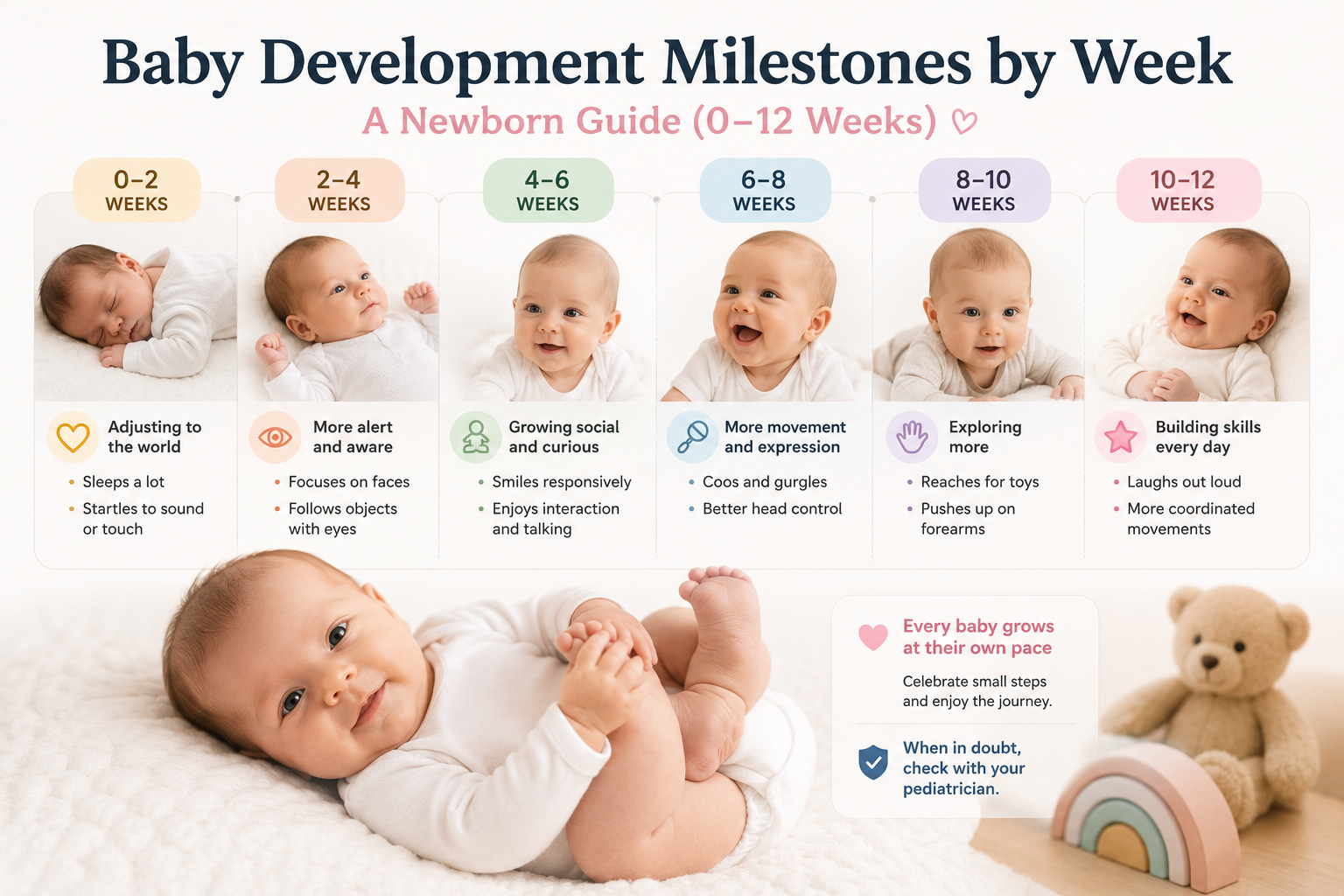
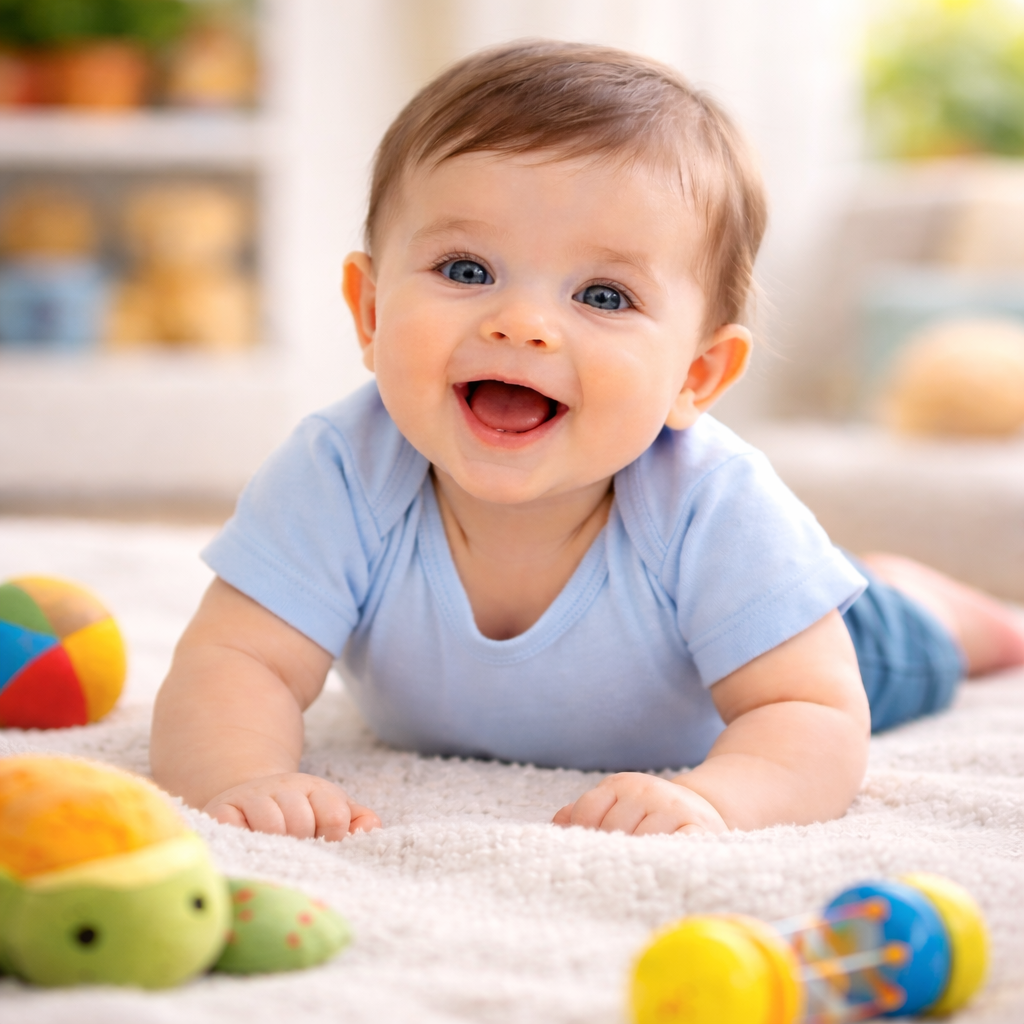
The 2-month-old baby development stage is a period when babies begin responding more clearly to the outside world. Facial expressions and sounds start to gain meaning, and babies observe their surroundings more consciously. During this month, smiling becomes more frequent and communication with parents grows stronger. The guide below explains everything you need to know about physical, cognitive, emotional, and social development in the second month.
What Can a 2-Month-Old Baby Do?
A 2-month-old baby begins showing their first social smiles. They respond to familiar faces and voices, make eye contact, and can briefly track objects. While lying on their tummy, they may lift their head for a few seconds. Turning toward sounds becomes more noticeable, and movements appear more intentional. Trying to touch their face or mouth with their hands is also typical at this stage.
Physical Development in a 2-Month-Old Baby
Muscle and Motor Skills
A 2-month-old baby can lift their head briefly and shows improved balance during tummy time. Neck muscles continue to strengthen, although full control has not yet developed. Arms and legs move more smoothly and in coordination, and some babies begin bringing their hands to their mouth.
- Tummy time should be practiced daily for short periods.
- Babies begin showing increased interest in their hands and feet.
- Reflexive movements gradually decrease as voluntary muscle control increases.
Growth Indicators
On average, a 2-month-old baby gains about 500–800 grams (1–1.7 lbs) and grows approximately 2–3 cm (0.8–1.2 inches). Head circumference should be monitored regularly, as brain development is very rapid during this period. Pediatric checkups should not be skipped, and vitamin D supplementation should continue as recommended by the doctor.
Sensory Development in a 2-Month-Old Baby
Vision and Hearing
During this month, eye contact becomes more consistent. Babies can recognize familiar faces and see objects more clearly from a distance of about 30–40 cm. High-contrast toys, especially black-and-white ones, attract their attention. Turning toward sounds begins, and babies respond to their parents’ voices.
Sensory Responses
Babies are sensitive to changes in tone of voice. Cheerful and gentle voices may be met with smiles. Facial expressions and mimics become early tools of communication. Talking, singing, and smiling frequently with your baby positively supports social development.
Social and Emotional Development in a 2-Month-Old Baby
The First Social Smiles
A 2-month-old baby begins showing true social smiles. These smiles are no longer reflexive but expressions of happiness toward familiar faces. This moment is extremely valuable for strengthening the parent–baby bond.
Babies may gaze at their parents’ faces for longer periods, react to voice tones, and begin imitating facial expressions. Establishing emotional bonding during this stage forms the foundation of a baby’s sense of security.
Cognitive Development in a 2-Month-Old Baby
At this stage, babies begin trying to make sense of the world around them. They start forming connections between sounds, facial expressions, and daily routines. Cause-and-effect relationships are not yet developed, but babies notice repeated actions and begin to remember familiar patterns.
- Colorful and moving objects attract their attention.
- Simple games like peek-a-boo support visual memory.
- Regular verbal interaction lays the foundation for language development.
Feeding Routine of a 2-Month-Old Baby
A 2-month-old baby typically feeds 7–9 times per day. Breast milk fully meets all nutritional and hydration needs. You can assess whether your baby is feeding well by monitoring wet diapers and weight gain. An average of 6–8 wet diapers per day indicates healthy feeding.
Formula Feeding
For babies who cannot receive breast milk, doctor-recommended formula may be used. The amount and preparation should strictly follow instructions. After each feeding, babies should be held upright to help release gas.
Sleep Patterns of a 2-Month-Old Baby
A 2-month-old baby sleeps an average of 15–17 hours per day. Sleep is still divided into short intervals, but nighttime sleep may begin to lengthen slightly. A basic sleep routine slowly starts to form during this month.
- Babies should always be placed on their back to sleep in a safe crib.
- Dimming the lights and reducing noise before bedtime is helpful.
- Lullabies or soft music can have a calming effect before sleep.
Activities for a 2-Month-Old Baby
1. Talking and Sound Interaction
Speak to your baby using a calm and clear tone. Respond to the sounds they make. This back-and-forth interaction is highly valuable for language development.
2. Visual Stimulation
Hang colorful, moving toys above the crib. As your baby begins tracking objects, their eye muscles will strengthen.
3. Massage and Skin-to-Skin Contact
Baby massage supports physical development and increases feelings of security. Gentle touch helps relax the nervous system and strengthens emotional bonding.
When Should You See a Doctor?
- If the baby has difficulty feeding or is not gaining weight,
- If there is no response to sounds or faces,
- If muscles appear extremely stiff or very floppy,
- If the baby is constantly unsettled or cries for long periods,
- If there is high fever, persistent jaundice, or bluish skin discoloration,
immediate consultation with a pediatrician is recommended.
Tips for Parents
During the 2-month-old baby development stage, a parent’s most important role is to provide a safe and loving environment. Eye contact, gentle touch, and frequent communication form the basis of emotional bonding. Every small smile is a sign that your baby recognizes you and is developing healthily.