What “Mathematics and Symbols” Mean in Baby Cognitive Development
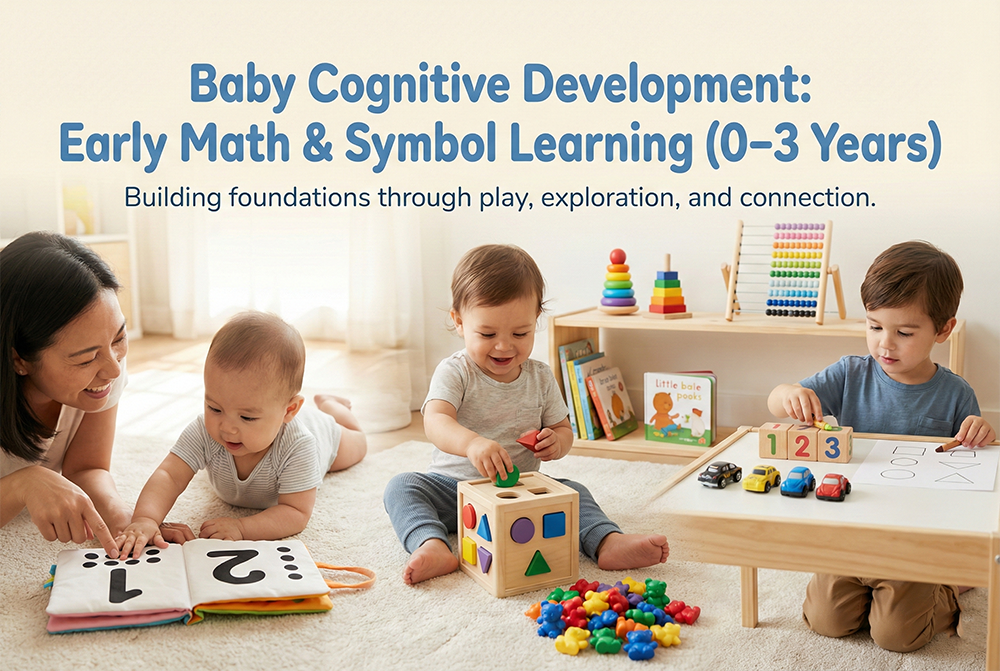
When most parents hear “math,” they picture counting worksheets or memorizing numbers. But in early childhood development, mathematics begins long before formal schooling. For babies and toddlers, early math is about noticing patterns, comparing amounts, understanding space, and learning that symbols (like words, gestures, pictures, and later numerals) stand for real things.
In the first three years, your child’s brain is rapidly building networks for attention, memory, language, and problem-solving—skills that support later learning in mathematics. These early foundations are sometimes called pre-math skills or early numeracy, and they grow best through warm, responsive interaction and playful everyday routines.
Core early math concepts babies learn through play
- Quantity: noticing “more” vs. “less,” “some” vs. “none,” and small sets (like one, two, three)
- Patterns: repeated sequences in sounds, movements, and objects
- Spatial thinking: where things are in relation to each other (in, on, under; near, far)
- Measurement ideas: big/small, full/empty, heavy/light, fast/slow
- Cause and effect: actions lead to predictable outcomes (shake = sound; push = roll)
What “symbol learning” looks like in infancy
Symbol learning is the ability to understand that one thing can represent another. Babies begin with social symbols (smiles, pointing, waving) and move toward language and pictures, and later numbers and letters. This is a huge cognitive leap: it requires memory, attention, and the ability to separate an object from what it represents.
Examples include:
- Recognizing that a caregiver’s pointing means “look there”
- Understanding that the spoken word “milk” refers to a drink
- Realizing a photo of a dog represents an actual dog
- Later, learning that the numeral “3” represents a quantity of three
The Science: How Babies Build Early Numeracy and Symbol Understanding
Research in developmental psychology and neuroscience suggests that babies come into the world with basic abilities to notice differences in quantity and patterns, and these abilities become more precise with development and experience. Importantly, babies learn best when information is meaningful, repeated in varied contexts, and shared within warm relationships.
1) Approximate number sense and comparing quantities
Even in infancy, many babies can distinguish between very different quantities (for example, “a lot” vs. “a little”), especially when the difference is large. This early “number sense” is not the same as counting, but it provides a starting point for later math learning. As babies grow into toddlers, they become better at comparing small amounts during play: two cookies vs. one, a full cup vs. an empty cup, a big pile vs. a small pile.
2) Subitizing: recognizing small quantities quickly
Young children often learn to recognize small quantities (like 1–3 items) without counting—this skill is called subitizing. You may see it when your toddler instantly knows there are “two shoes” or “three blocks” without pointing and counting. Subitizing supports later addition and number understanding because it builds a stable sense of small sets.
3) Working memory, attention, and executive function
Early math and symbol learning rely on attention control (staying focused), working memory (holding information in mind briefly), and inhibition (pausing before acting). These “executive function” skills are shaped by brain development and caregiving experiences, including predictable routines, responsive communication, and opportunities for independent problem-solving.
4) Language and “math talk” as a bridge to symbols
Language helps babies map experiences to meaning. When parents label quantities, comparisons, and spatial ideas in everyday life, children get repeated practice connecting words (symbols) to concepts. This doesn’t require formal teaching. Short, natural phrases—“two socks,” “more peas,” “big truck,” “under the table”—add up over time.
Age-by-Age Milestones: Birth to 3 Years
Every child develops at their own pace, and skills emerge unevenly. Use this section as a general guide, not a test. If your child was born preterm, consider adjusted age when thinking about early milestones.
0–6 months: foundations for patterns, attention, and cause-effect
- Tracks movement and notices changes in light, sound, and rhythm
- Enjoys repetition (same song, same bounce)
- Begins cause-effect learning (kicking makes a mobile move; shaking makes a rattle sound)
- Recognizes routines (bath time sequence, feeding cues)
How to support: Use gentle repetition, rhythmic songs, and predictable routines. Pause to let your baby anticipate what comes next.
6–12 months: exploring “more/less,” object permanence, and early gestures
- Explores objects by banging, dropping, filling, and dumping
- Understands familiar words and may respond to “no,” “bye-bye,” or their name
- Develops object permanence (things exist even when out of sight), which supports later symbolic thought
- Uses gestures like reaching, showing, and pointing (often emerging toward the end of this period)
How to support: Play simple hide-and-find games, offer nesting cups, and narrate what your baby is doing (“in,” “out,” “more”).
12–24 months: quantity words, sorting, and “pretend” as symbol practice
- Begins using number words (often not accurately at first)
- Sorts by simple features (all the red blocks, all the round lids)
- Engages in pretend play (a banana becomes a phone), a big leap in symbolic thinking
- Follows simple directions with spatial terms (on, in, out) as language grows
How to support: Offer opportunities to match, sort, and pretend. Use short, clear “math talk” during routines.
24–36 months: counting routines, comparing, and early number-symbol links
- Enjoys counting objects (often with mistakes; this is normal)
- Understands “one” and “two” more reliably and begins grasping “how many”
- Compares big/small, tall/short, more/less with growing accuracy
- Recognizes some symbols (logos, signs, possibly a few numerals or letters)
How to support: Count real objects during play, compare quantities in daily life, and connect numerals to small sets in a fun, low-pressure way.
Practical, Evidence-Based Ways to Teach Early Math Through Daily Life
You do not need special materials or formal lessons. The most powerful approach is everyday, relationship-based learning: you notice what your child is interested in, name it, and invite them to explore.
1) Use “math talk” naturally (without turning it into a lecture)
Children learn concepts faster when adults use varied, meaningful language about quantity, comparisons, and space.
- Quantity: “You have two crackers.” “Let’s get one more.”
- Comparisons: “This tower is taller.” “That bowl is full.”
- Spatial words: “Your shoe is under the chair.” “Put it in the box.”
- Time/sequence: “First diaper, then pajamas.”
Tip: Aim for short phrases while your child is looking or touching the object. Timing matters more than complexity.
2) Count what matters to your child
Counting is meaningful when it connects to your child’s goals.
- Count steps as you climb: “1, 2, 3…”
- Count blueberries into a bowl
- Count fingers during handwashing (quick and playful)
- Count toy animals as they line up
Tip: In the toddler years, it’s common to recite number words like a song without understanding quantity. That’s still useful practice—later the meaning “clicks” with repeated experiences.
3) Build patterns with sound and movement
Patterning supports later math because it strengthens prediction and sequencing.
- Clap-stomp-clap-stomp and pause to let your child continue
- Alternate spoon and fork while setting the table
- Make a simple bead pattern (big-small-big-small) for older toddlers
Tip: Keep patterns simple at first. If your child loses interest, shorten the sequence.
4) Encourage sorting and matching
Sorting is early data science: children decide what “goes together” and practice categorization.
- Sort socks by size or color
- Match lids to containers
- Group toy cars vs. stuffed animals
- Put all circles on one page and squares on another (older toddlers)
Tip: Let your child choose the rule sometimes. If they sort by “all the shiny ones,” that still builds reasoning.
5) Make space and shapes part of play
Spatial thinking predicts later success in STEM fields and develops through hands-on exploration.
- Stack blocks and talk about balance (“It tipped because it was too far over.”)
- Use terms like “behind,” “next to,” “between” during play
- Play with shape sorters, but don’t worry if your child uses trial-and-error
- Do simple puzzles together and name the strategies (“turn it,” “flip it,” “try another side”)
Tip: Praise effort and strategies rather than “being smart.” This supports healthy persistence.
6) Use everyday measurement words
Measurement ideas are everywhere, and they help children understand comparison and change.
- At bath: “The cup is full.” “Now it’s empty.”
- In the kitchen: “Let’s pour a little milk.” “That’s too much.”
- Outside: “We walked far.” “That hill is steep.”
Helping Babies Learn Symbols: From Gestures to Pictures to Numbers
Symbol learning isn’t just about flashcards. It’s about building a bridge between your child’s real-world experiences and the representations we use to communicate. Strong symbolic understanding supports language, literacy, and later math.
Start with gestures and shared attention
Joint attention—when you and your baby focus on the same thing—supports word learning and symbolic thinking. Pointing, showing, and taking turns help your baby understand that communication can represent ideas.
- Follow your baby’s gaze and label what they notice
- Point to an object, then hand it to your baby
- Play turn-taking games like rolling a ball back and forth
Use books as “symbol practice”
Pictures are symbols. When you read together, you’re helping your child understand that a drawing stands for something real.
- Choose sturdy board books with clear images
- Point and label: “Dog. Woof!”
- Ask simple questions for toddlers: “Where is the banana?”
- Connect pictures to life: “We saw a bus like that today.”
Tip: It’s fine if you don’t read every word. Responsive, back-and-forth “book talk” is powerful.
Introduce numerals and counting symbols gently
For toddlers, numerals (1, 2, 3) are abstract symbols. Instead of drilling, connect numerals to real sets.
- Write a big “2” and place two stickers next to it
- Use a simple counting book and count the objects on each page
- Point out numbers in the environment casually (elevator buttons, calendar), without quizzing
Tip: If your child isn’t interested, pause and return later. Pushing can backfire and reduce curiosity.
Play Activities by Age (Simple, Low-Prep, High Impact)
0–12 months
- Drop-and-listen: From a seated position, let your baby drop a safe toy and narrate: “Down!” “It fell.”
- Peekaboo variations: Cover your face, then a toy, then part of the toy to build prediction
- Fill and dump: Offer a basket and soft items; name “in” and “out”
- Rhythm routines: Bounce-bounce-pause and wait for your baby’s response
12–24 months
- Snack math: Give two pieces, then ask, “Want more?” and model “one more”
- Sock sorting: Match socks; talk about “same” and “different”
- Shape hunt: Find circles and squares in the room (plates, windows)
- Container play: Lids, boxes, and cups to explore size and fit
24–36 months
- Counting with movement: “Let’s do 5 jumps.” Count together
- Toy line-up: Line up animals and count; compare “more animals” vs. “fewer cars”
- Pattern art: Stamp-dot-stamp-dot with washable markers
- Simple board games: Games with turn-taking and counting steps (keep it short)
What to Avoid: Common Myths and Pressure Traps
Myth: Babies need flashcards to learn math
Babies learn best through sensory exploration and real interactions. Flashcards can be neutral, but they are not necessary and may be less effective than play-based learning that includes touch, movement, and conversation.
Myth: Early math means pushing academics early
Strong early numeracy comes from foundational skills: language, attention, self-regulation, and curiosity. A calm, responsive environment supports brain development more effectively than pressure or performance expectations.
Avoid “testing mode”
When adults frequently quiz (“How many is this?” “What number is that?”), some toddlers become anxious or resistant. Instead, model and wonder together: “I see three!” “Let’s count.”
Supporting Cognitive Development Through Wellness: Sleep, Nutrition, and Stress
Baby cognitive development isn’t just about activities. The brain builds skills best when the body’s basic needs are met.
Sleep and learning
Sleep supports memory consolidation. Babies and toddlers need adequate sleep for attention and learning. If sleep is challenging, consistent routines and age-appropriate schedules can help.
Nutrition and brain growth
A balanced diet supports brain development. For infants, breast milk and/or formula provides key nutrients. For toddlers, regular meals with protein, healthy fats, iron-rich foods, and a variety of fruits and vegetables supports energy and attention.
Stress and the learning environment
All families experience stress. What matters is having enough moments of safety and connection. Warm, responsive caregiving supports emotional regulation, which in turn helps learning. If you feel overwhelmed, seeking support is a strong, protective step for your child’s wellbeing.
When to Seek Professional Guidance
Children develop on a wide range of timelines. Consider discussing development with your pediatrician or an early intervention professional if you notice:
- Limited eye contact or difficulty engaging in back-and-forth interaction
- Few gestures (like pointing, showing, waving) by around 12–18 months
- Loss of previously learned skills
- Persistent difficulty hearing or responding to sounds (hearing supports language and symbol learning)
- By age 2, very limited interest in interacting, playing, or communicating
Early support can be very effective, and asking questions early does not label your child—it helps you understand how to best support them.
Key Takeaways for Parents
Baby cognitive development in mathematics and symbols grows through everyday life: routines, play, language, and connection. You don’t need to “teach math” in a formal way. Instead, offer rich experiences—count small sets, talk about “more/less,” play with patterns, and read picture books. Over time, these tiny moments build strong foundations for later learning, while protecting what matters most in early childhood: curiosity, confidence, and a secure relationship with you.