Why a Week-by-Week Newborn Milestones Guide Helps
The first three months can feel like a blur of feeding, diaper changes, and short naps. A baby development milestones by week guide offers a gentle roadmap—what many babies tend to do around each week—while honoring an important truth: healthy babies develop on a range of timelines.
Newborn development is driven by rapid brain growth, nervous system maturation, and increasing ability to regulate basic functions like temperature, sleep-wake cycles, and feeding. Milestones are not a test your baby must “pass.” They’re a way to notice progress, support development with simple daily habits, and recognize when it’s worth checking in with your pediatrician.
How to use this guide
- Look for patterns, not single moments. A skill may appear briefly, disappear, then return stronger.
- Adjust for prematurity. If your baby was born early, many clinicians track milestones by corrected age (due date-based age) for the first year or two.
- Bring notes to well visits. Short observations about feeding, sleep, movement, and crying can help your pediatrician personalize guidance.
Newborn Milestones: Week-by-Week (0–12 Weeks)
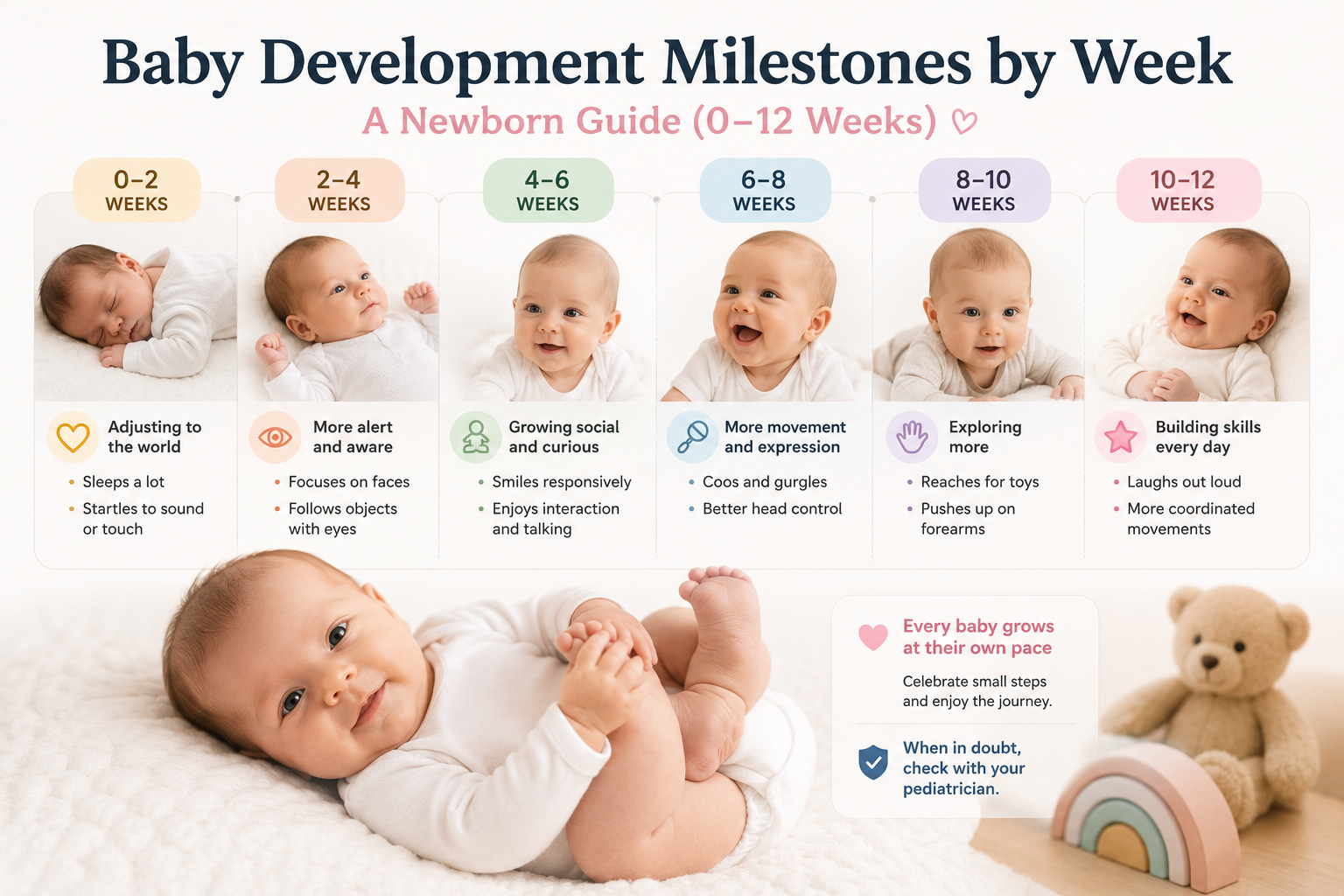
Below are typical newborn milestones by week across movement, senses, feeding, sleep, and social development. Your baby may show some skills earlier or later and still be thriving.
Week 1 (Days 1–7): The “Fourth Trimester” Begins
What you may notice
- Reflexes are prominent: rooting (turning toward touch on the cheek), sucking, startle (Moro), grasp.
- Vision is blurry; baby focuses best at close range (about the distance from your arms to your face during feeding).
- Feeding is frequent and sometimes cluster-like as milk supply establishes.
- Sleep occurs in short stretches, often 14–17 hours over 24 hours, without a set schedule.
How to support development
- Skin-to-skin supports bonding, temperature regulation, and feeding.
- Talk softly and hold baby close—your voice is a powerful regulator.
- Safe sleep basics: alone, on the back, on a firm flat surface, with no loose bedding.
Week 2: More Alert Moments
What you may notice
- Short windows of calm alertness increase.
- Baby may briefly track a face or high-contrast object.
- Stools and feeding patterns may shift (especially as milk transitions).
How to support development
- Offer high-contrast visuals (black/white patterns) within close range.
- Try tummy time for very short periods (even 1–2 minutes), always supervised, when baby is calm and awake.
Week 3: Stronger Reflexes, More Communication Cues
What you may notice
- Baby may lift the head briefly during tummy time.
- Increased cues: turning away when overstimulated, rooting when hungry, quieting with your voice.
- More gassiness is common as the digestive system matures.
How to support development
- Use responsive feeding: watch cues rather than the clock.
- Practice paced bottle feeding if bottle-feeding to support coordination and reduce overfeeding.
Week 4: Early Social Engagement
What you may notice
- Baby may briefly hold their head up a little longer during tummy time.
- Some babies show early “almost-smiles” (often reflexive at first).
- Increasing interest in faces; baby may calm when held upright and close.
How to support development
- Offer face time: speak slowly, pause, and let baby respond with movements or sounds.
- Keep stimulation gentle—newborns can become overwhelmed quickly.
Week 5: Growing Awake Time, Early Vocal Sounds
What you may notice
- Longer awake windows (still short overall).
- More coo-like sounds may begin, especially when calm.
- Improved ability to briefly fix on a face.
How to support development
- Narrate your day: “Now we’re changing your diaper.” Language exposure supports brain development.
- Offer supervised tummy time after a diaper change when baby is content.
Week 6: Peak Fussiness for Many Babies
What you may notice
- Crying may increase and often peaks around this period for many infants.
- Baby may want more soothing: rocking, swaying, bouncing, white noise.
- Some babies begin social smiling around this time (it may also arrive later).
How to support development
- Use a soothing checklist: hunger, diaper, temperature, burp, comfort, fatigue.
- Try the “calm down” basics: swaddle (if appropriate and baby isn’t rolling yet), side/held position, shush/white noise, gentle swinging, sucking (pacifier if desired).
- Caregiver support matters: if you feel overwhelmed, place baby on a safe surface and take a short break. Ask for help.
Week 7: More Smiles, Better Head Control
What you may notice
- Smiles may become more consistent in response to your face or voice.
- Baby may lift head higher in tummy time and turn it from side to side.
- Hands may open more often (less tightly fisted).
How to support development
- Encourage midline play: bring hands toward the center of the body during playtime.
- Switch sides when holding and feeding to support symmetrical development.
Week 8: Early “Conversations” and Stronger Visual Tracking
What you may notice
- More cooing and vowel sounds (“oo,” “ah”).
- Better ability to track objects horizontally with the eyes.
- Baby may briefly calm when you talk and then “answer” with a sound.
How to support development
- Practice serve-and-return: baby coos, you respond, baby responds again. This supports communication and social-emotional growth.
- Offer a simple rattle sound from one side, then the other, to encourage turning.
Week 9: Stronger Body Control and More Curiosity
What you may notice
- Baby may bring hands to mouth more often for self-soothing.
- Improved head steadiness when held upright (still needs support).
- More interest in lights, windows, and contrasting edges.
How to support development
- Short, frequent tummy time sessions often work better than one long session.
- Give baby a moment to try before stepping in—support without rushing.
Week 10: Emerging Routines and More Intentional Smiles
What you may notice
- Smiles may be clearly social and frequent.
- Baby may tolerate play for longer periods when well-rested and fed.
- Sleep may begin to consolidate slightly at night for some babies (not all).
How to support development
- Create a simple bedtime rhythm: dim lights, quiet voice, feed, brief cuddle, then sleep on a safe surface.
- Offer a variety of positions during awake time (in arms, on a mat, tummy time) to build strength.
Week 11: More Sounds and Early Turn-Taking
What you may notice
- Baby may “talk” more with coos and squeals.
- They may show excitement with whole-body wiggles when they see you.
- Improved tracking and attention span.
How to support development
- Pause after you speak to “make space” for baby’s response.
- Read simple books with high-contrast images; it’s about connection, not finishing pages.
Week 12: Building Strength, Social Connection, and Predictability
What you may notice
- Head control is stronger; baby may lift chest slightly during tummy time.
- More consistent smiles and engagement; some babies laugh later, but joyful sounds may start.
- Hands may bat at toys; grasping becomes more intentional over time.
How to support development
- Offer safe opportunities to reach: place a toy near midline and slightly to the side.
- Keep routines flexible—predictable patterns help babies feel secure even if timing varies.
Key Newborn Development Areas (What Matters Most)
Motor development: from reflexes to control
Newborn movement starts reflex-driven and gradually becomes more voluntary. In the first 12 weeks, the big themes are head and neck strength, bringing hands to midline, and increasing smoothness of movement. Small daily practices—like supervised tummy time and varied holding positions—can support healthy muscle development.
Sensory development: vision and hearing are “online” early
Babies are born able to hear, and they often prefer human voices—especially a parent’s. Vision starts blurry and becomes clearer with time. Newborns typically prefer faces and high-contrast shapes. Gentle exposure is enough; overstimulation can lead to fussiness and turning away.
Social-emotional development: regulation through relationship
Newborns can’t self-regulate well. They rely on caregivers to help them settle through holding, feeding, movement, and voice. Responding consistently does not “spoil” a newborn—it builds trust and supports emotional development. Over time, you’ll see longer calm-alert periods and more social cues (eye contact, smiles, coos).
Feeding development: coordination improves week by week
Whether breastfed, formula-fed, or combination-fed, feeding is both nutrition and neurological practice. Babies refine the coordination of suck–swallow–breathe over time. Many newborn challenges (spit-up, gas, frequent feeds) are common early and usually improve as the digestive and nervous systems mature.
Practical Tips to Support Newborn Development (Everyday Actions)
1) Make tummy time doable
- Start small: 30–60 seconds counts.
- Try “tummy-to-tummy” on your chest or across your lap if the floor is too hard.
- Aim for multiple short sessions daily, building gradually as baby tolerates.
2) Follow baby’s lead for interaction
- When baby looks away, yawns, spreads fingers, or arches, that can mean “I need a break.”
- When baby is calm-alert, try face-to-face talking, singing, or gentle play.
3) Support sleep without rigid schedules
- Watch wake windows: newborns often handle only short awake periods before becoming overtired.
- Use consistent cues: dim lights, swaddle (if appropriate), white noise, and a brief soothing routine.
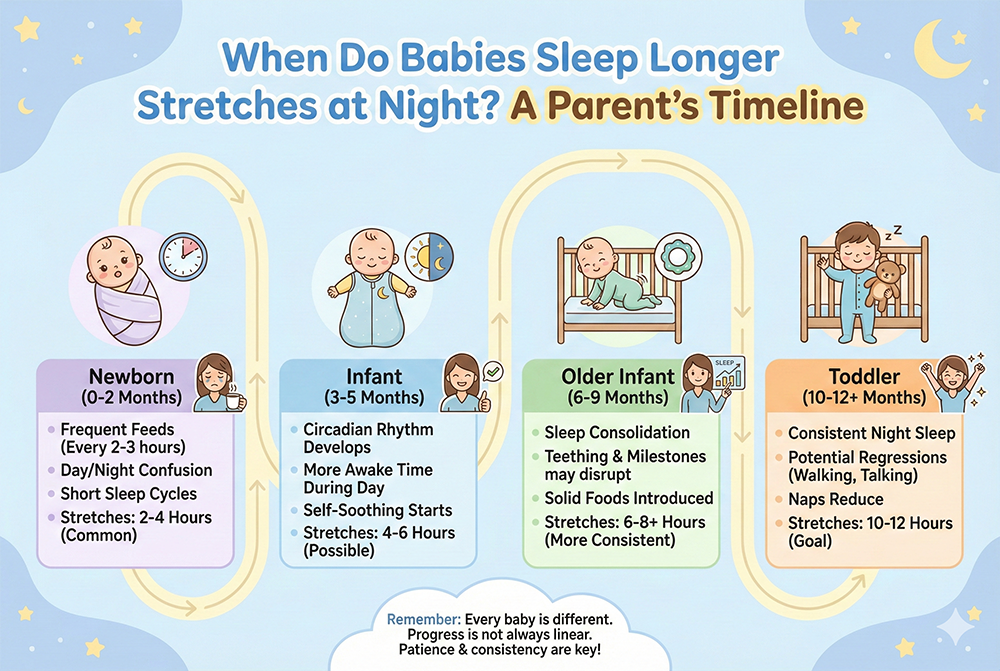
- Remember: frequent night waking is biologically normal in early weeks.
4) Encourage healthy head shape and neck mobility
- Alternate the direction your baby faces in the crib (still always placing on the back to sleep).
- Switch arms during feeding and carrying.
- Limit long stretches in car seats, swings, or loungers when not needed for transport or safety.
5) Build brain architecture with simple “serve-and-return”
When baby coos, looks at you, or moves their arms, respond with warmth: a smile, words, or mirroring their sound. This back-and-forth is a powerful, evidence-supported way to support early learning and attachment.
When to Talk to a Pediatrician: Red Flags in the Newborn Period
Trust your instincts. If something feels off, it’s always appropriate to seek medical advice. Contact your pediatrician promptly (or seek urgent care/emergency services as appropriate) if you notice any of the following:
- Feeding concerns: poor feeding, very weak suck, significantly fewer wet diapers than expected for age, persistent vomiting (especially forceful/projectile), signs of dehydration (very dry mouth, no tears when crying later on, sunken soft spot).
- Breathing changes: rapid breathing that doesn’t settle, struggling to breathe, bluish lips/face, persistent grunting.
- Unusual sleepiness: hard to wake for feeds repeatedly, markedly decreased responsiveness.
- Fever: for babies under 3 months, a rectal temperature of 100.4°F (38°C) or higher is typically considered urgent.
- Jaundice that is worsening or spreading, or baby is very sleepy and feeding poorly.
- Movement concerns: very stiff or very floppy body tone; persistent asymmetry (always turning head one way); not moving one side well.
- Developmental concerns: by 8–12 weeks, no moments of alert engagement at all, no response to loud sounds, or no attempt to visually fix/track (keeping in mind variability and vision maturation).
Note: Milestone timelines vary, but red flags focus on safety, basic functioning (feeding/breathing), and significant deviations in responsiveness or movement.
Common Parent Questions (And Reassuring, Evidence-Based Answers)
Is it normal if my baby isn’t smiling at 6–8 weeks?
Many babies begin social smiling somewhere in the 6–12 week range. Some smile earlier, some later. Try engaging when baby is calm-alert, well-fed, and comfortable. If you’re not seeing any social engagement (brief eye contact, calming to voice, any smiles) by around 12 weeks, bring it up at your next visit.
What if my newborn hates tummy time?
This is extremely common. Start with tiny sessions and try alternatives like tummy time on your chest, across your lap, or using a rolled towel for support (always supervised). Consistency matters more than duration. Gradual strengthening usually improves tolerance.
Are there milestones I should track more than others?
In the newborn period, the most useful “big picture” markers are: feeding effectiveness and growth, increasing alertness, improving head control, and social engagement (calming to caregiver, eye contact, emerging smiles). If those are trending well, smaller variations (like when cooing starts) are usually not concerning.
How to Track Baby Milestones Without Anxiety
- Use short notes once a week: one new thing you noticed, one question you have.
- Compare baby to themselves, not to other babies or social media timelines.
- Focus on connection: warmth, responsiveness, and safe routines support development across domains.
- Ask early: if you worry, bring it up. Early reassurance (or early support) helps everyone.
Final Takeaway: Your Baby’s Pace Can Be Perfectly Normal
The newborn stage is intense because your baby is learning how to be in the world—breathing, feeding, sleeping, and relating to you—while their brain and body grow rapidly. Use this newborn milestones week by week guide as a supportive reference, not a strict checklist. If you’re ever unsure, your pediatrician is your best partner in interpreting milestones in the context of your baby’s health, birth history, and growth.